Friday, November 18, 2016

Game On!

Games make a great gift, especially if you are looking for gifts that will be good for the whole family. In a day and age where kids seem to be connected to some kind of electrical device more often than not, it is nice to know that there are lots of game options out there that will keep the whole family entertained.  When picking games, I wanted to be sure that they could help in the development of fine motor, gross motor and/or visual skills.  I also wanted to be sure that they would help in encouraging good social skills, including good sportsmanship.  Many of these games can be adapted based on a child's skill level and his/her needs.

Here are my top picks for the 2016 Holiday Gift Guide:
Happy Salmon-this simple, fast-paced card game that combines visual perceptual and gross-motor skills.  Everyone flips cards over their action card after they flip it over; if two people shout out the same action, they celebrate by doing that action together.  The first person to match all their cards in their deck wins.

Giggle Wiggle-this is an updated version of the Scatterpillar Scramble game.  Kids race to get all the marbles in the hands of the moving caterpillar.  Great for working on improving eye-hand coordination, fine motor skills and focus, attention and regulatory skills.  For younger children, you can decrease the level of difficulty by not turning the game on while they are trying to put the marbles on.


Willy's Wiggly Web-this cooperative game combines teamwork and the development of fine motor and cutting skills, eye-hand coordination, counting skills and recognizing left and right hands.  The purpose of the game is to cut all the bugs free from the web before the spider falls from the top of the web. Once the web and all the bugs are in place, kids pick cards and then follow the instructions to cut the web.

ListMania-this cooperative game for kids 7 and older requires them to take turns to make a list of items in alphabetical order.  This is great for working on imagination skills, organizational skills, focus, attention and regulation skills.  If you want to work on improving handwriting, this could be a fun way to get them motivated to write!  Some of the things you can write about are body parts or things you do at the beach.  There are three different ways to play the game.

Pancake Pileup-this is a favorite for the kids I work with!  In this relay style game,  kids have to pile up pancakes in the correct order based on which card they pick up.   Place the pancakes on one of the room and a plate on the other side and kids have to run back and forth while stacking them up.  Great for working on gross motor skills, balance and coordination, focus and attentional skills, visual motor and visual perceptual skills.  You can encourage social skills by having kids work in teams when playing this game.

Tumbling Monkey Stick Game- this has been a fine motor favorite of mine for a long time.  Much like the game Kerplunk but instead of marbles, there are monkeys that you are trying to get out of the tree.  Great for working on developing fine motor and grasping skills, eye-hand coordination, problem solving, organizational skills, attention and focus.  This game can be adapted to be easier or harder depending on children's skill level.

Yeti In My Spaghetti-another great game to work on the development of fine motor and grasping skills.  Place a bunch of plastic spaghetti pieces on top of a bowl and then put the yeti on top.  The point of the game is to pick out a piece of spaghetti from the pile without letting the yeti fall into the bowl.  This has been a big hit with all my preschool and school age kids!  In addition to working on fine motor skills, kids can work on improving eye-hand coordination, problem solving and organizational skills and improve social skills when playing the game.


Thumbs Up-the goal of this game is to be the first to stack a series of rings on their thumb based on the card they choose. Each card has different pictures with different colored objects and numbers on it.  Great game for learning colors, improving visual attention and eye-hand coordination, focus and attention and processing speed.  Can be adapted for kids of different ages and skill levels.

Sturdy Birdy: The Game of Perfect Balance-this game focuses on improving gross motor, balance and coordination skills.  There are 12 cards with different poses on them and kids have to master each one in order to win the game/make it to the end of the line.  They roll the dice to find out where to place a beanbag and how long to hold the position. Everyone counts while the pose is being held which helps in developing good sportsmanship skills.


Wednesday, November 2, 2016

Jump for Joy!


As many of you have noticed, the holiday gift guides and catalogues are starting to clog up our inbox and mailbox.  For the most part, I dump these things into recycling before even looking at them.  The exception are the ones that feature toys.  I am always on the lookout for new toys and gifts that will be good at work.  One of my favorites is Fat Brain Toys which I could get lost in for hours if I had the time.  I won't lie, I've made many unnecessary but amazing purchases from here for kids of all ages!

Yesterday, while looking through their new products, my eyes went right to a new trampoline that they were featuring.  As a New York City based pediatric occupational therapist, one of the things that I do is give parents and teachers ideas on how they can incorporate some of the activities I am doing our sessions at home and in school.  The biggest problem I face is the lack of space many New Yorkers have.  Asking parents to get a big therapy ball or a trampoline seems totally reasonable but if you live in a small apartment or have a classroom with not much free space, it becomes more trouble figuring out where to put it when it's not in use.  So when I saw the Foldaway Trampoline, I was thrilled and had to share it with everyone.  Even if you have space in your house/apartment/classroom, you may not want to have a trampoline out at all times so the Foldaway Trampoline is the perfect option for those of you who feel that way!  It is simple to open, close and store without taking up much space.  For older children, you can teach them how to open and close it so when they feel like they might have some extra energy that they need to get rid of, they can go and take care of it on their own.  I really like that the bar on the trampoline offers some of the younger kids, or those who have trouble with balance, extra support making them feel more secure and stable while jumping.


I believe having a trampoline available for younger children who may have sensory or gross motor difficulties is a great thing and that there are many benefits besides just releasing some extra energy.  Here are some of the other benefits of jumping on a trampoline:
-provides proprioceptive input which helps improve body awareness and organizational skills
-works on improving motor skills such as bilateral coordination.  When jumping, both sides of the body and brain must coordinate in order to maintain balance
-it's a fun way to work on building endurance and overall body strength.
-great for working on modulation and regulation skills
**you can play a game of freeze jump to work on increasing the length of time they jump.  Kids have to jump until the music stops!**

So if you are on the lookout for an easy to store sensory tool, be sure to check out the Foldaway Trampoline.  If you happen to know of any other great sensory products like this, please be sure to tell me about them.  I am always on the lookout for new products and love hearing from all of you! Remember, I am only a click away!


Tuesday, October 4, 2016

It's All About the Self-Care Skills

Whenever I tell people what I do as an occupational therapist, I tell them I get to play with some of New York City's coolest kids.  And while that is totally true, oftentimes, there is more to my job than just that.  One of the parts of my job that is almost more important than teaching them how to properly hold onto a writing instrument is to teach them to be more independent for self-care skills.

Having a child who is independent in feeding themselves, getting themselves dressed and to be comfortable/happy with their clothing, tying their shoes and all other aspects of self-care skills is something that us parents of typically developing children may take for granted.  The good thing is that there are a lot of smart and creative people, most often people who have once worked with children with disabilities or parents of those kids, who have created some really amazing products to help make life easier for families.

Below, you will find some of the products that I recommend to families, therapists, teachers, etc. to help make life easier.  And when I say easier, I also mean to help make kids feel more independent during these activities so they can build confidence and self-esteem.

Reflo Smart Cup-one of the things I am asked to work on with my kids is drinking from an open top cop.  As a parent, we love the idea of spill-proof sippy cups but as kids get older, they need to learn how to drink from a regular cup.  One of the biggest obstacles for the kids I work with is to learn how to grade their movements when drinking from a regular cup so that the water doesn't spill all over their face.  One of the best training cups I have seen was one that was recommended by a friend who is also a speech therapist.  The Reflo Smart Cup is a simple plastic cup that has an insert you slip into the cup that slows down the flow of the liquid.  I have recommended this to lots of parents and other therapist friends over the years and everyone has loved them.  They have seen kids who refused to try a variety of cups become independent cup drinks after just a short amount of time practicing using the Reflo.  This cup is perfect for all kids, but especially great for children who may present with motor control/movement or other physical disabilities.  Best part, the cup is affordable and lightweight which makes it easy to throw in a big and take with you wherever you may go.

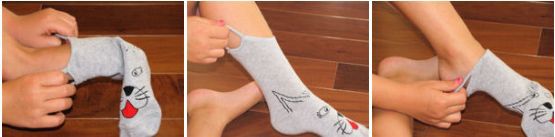
EZ Sox-I've been a huge fan of EZ Sox since I first learned about them.  EZ Sox are super cute and comfortable socks that have a loop on either side of the sock.  These loops serve a really important purpose:  they are there so kids can put their thumbs in them so they can easily pull a sock up over their heels.  Additionally, many of the socks are animals with the face on the front side and a tail on the back side.  It's a great visual cue for kids to know that their socks are on the right way.
I can't tell you how much time I have spent trying to teach kids how to put socks on their feet, but it's a whole lot of time.  Several years ago, I was introduced to EZ Sox and they have made every Holiday Gift Guide of mine since and have been recommended to more people than I can count.  And to make it clear...I recommend the EZ Sox to all parents, not just the parents of the kids I work with, because we just want our kids to be able to help with the whole getting dressed process.  My nieces and daughter all learned how to put socks on their feet by using EZ Sox.
I haven't personally used any of their other products, but I love how this company has evolved over the years.  They now have underpants/boxers and a whole line of adult products which is great because many of the kids I have and will work with have physical disabilities that may have a direct impact on the level of independence for dressing/undressing skills for their entire lives.

Zoo Sticks-meal time can be such a nightmare for parents.  Kids getting up and down from the table a hundred times is enough to make a parent crazy!  What drives me totally crazy is when I look over and see my 6 year old daughter using her hands to feed herself.  One of the things that I have used with her, and have suggested to a lot of the parents who have the same frustration, are using kid-friendly chopsticks.  Not only are the Zoo Sticks great for working on improving fine motor skills, grasp strength and coordination skills, they are super motivating for kids who seem to be reluctant to using forks and spoons.  Find an animal that your kid is really interested in and I promise you that you won't see them using their fingers to feed themselves!
For younger kids, check out this awesome new product by Skip Hop.  Their Zoo Little Training Chopsticks were designed with little hands in mind!  As someone who has never learned how to properly use chopsticks, I am excited about these chopsticks that will introduce the littles to using them at a very early age!


Suction Cup Plates and Bowls-some of the kids I work with have a really difficult time with bilateral coordination, the ability to use two hands at the same time during activities.  So that can make them being independent during mealtime challenging.  To go back to the fact that we can take for granted that our kids are independent, imagine having a kid who doesn't really have the ability to use two hands at the same time.  Whether it be because of a physical disability, decreased strength or coordination, there are some kids who just don't use two hands at the same time.  When you are eating, being able to use two hands is important....you need one hand to hold a fork or a spoon and the other to hold the plate or bowl.  The good news is that if you happen to have a kid who may be struggling with this, there are options.  There are a lot of great suction cup options out there that will help encourage independence.  The thing with suction cup plates and bowls is that if your child is struggling with feeding, they will take away some of the work.  Here are a few
Beary Hungry Suction Placemats-this placemat not only sticks snuggly to a tabletop surface, it is broken into sections so if you happen to have a kid who doesn't like foods to touch, this is your thing.  For the more difficult food to scoop up, you can place them in a spot where there is a lip and they can scoop their food up easier.
Tomy Toddler Suction Plate-this 3-section plate will stick to a high-chair or any flat surface.  I love that it has a lipped surface which makes it easier for kids who struggle with scooping food off of a plate a little bit easier.

Soft Clothing (clothing and accessories for kids with tactile sensitivity)-one of the biggest struggles that my kids with sensory processing difficulties have is finding clothing that they feel comfortable in.  Some kids don't like the feeling of buttons/snaps/elastics/etc. against their skin.  Jeans or pants are too stiff and uncomfortable.  The seams in socks and underpants can send a kid to place of such discomfort that parents end up letting their kids go without them to avoid a complete meltdown.
Super soft t-shirt from Pickybunny
When I first began practicing years ago, parents felt like their only option was sweatpants and t-shirts.  Now, there are a lot of different options that are both sensory friendly and fashionable.  I love that there are options for parents and kids when it comes to clothing because I know just how big of an impact not feeling comfortable in your clothing can have on whether or not you have a good day.
Here are a few places you should check out if on the lookout to help make dressing time less stressful for everyone:
SmartKnit Kids-they have a large selection of seamless products for those super-sensitive kids who always seem to feel a bump or wrinkle.  Their socks, underwear, undershirts and bralettes are made out of a very soft fabric that reduces wrinkles.
Pickybunny Clothes-this line of girls clothing and pajamas are not only really cute, but have 3 different levels of softness to choose from depending on how sensitive your child is:  soft, super soft and heavenly soft.  I kinda wish some of their stuff came in my size!
Lucky and Me-another company that took picky and sensitive kids into consideration when they designed their girls and boys underwear collection.  Made of super soft, organic cotton, these tagless undergarments are an affordable and stylish option for your sensitive child.
Jorgensons-this family run company knows the importance of knowing that when kids are comfortable in their clothing, they will have increased confidence, self-esteem and be able to function better during their day.  Their clothes are not only soft and seamless and tagless, they are really cool too!  The hole for the head to go through is larger than typical shirts so there is no struggle or worry about their heads getting stuck while dressing.
Independence Day Clothing-this line of clothing which was recommended by my colleague Lindsey Biel.  There are no seams and it doesn't matter what way they are put on.  Kids will be able to dress themselves independently and comfortably.  There are no tags, there are no buttons, snaps or zippers and all clothes can be worn inside or out.

U-Lace-one thing I have found in my years as an occupational therapist is that kids are learning how to tie shoes much later than we were younger. There are so many slip-on, zipper and velcro options when it comes to shoes that kids just don't need to learn this skill.  For some of the kids I work with, those with significant fine motor, motor planning and executive functioning delays, learning how to tie shoes is almost impossible and not something that I find should be a priority when looking at the bigger picture.  When it really comes down to it, some kids will never learn to tie their shoes and that's okay.  They will learn a million other things that are far more important and will allow them to be independent.
As kids get older though, they will need more than just slip-on shoes and velcro just doesn't look right after a certain age.  U-Lace turns any sneaker into a slip on shoe.  Simply put, they are elastic bands that you put into your shoes.  Due to the nature of the fabrics/fibers that they have used, they don't stretch out and will keep your feet securely in place.  They come in a variety of colors and patterns and can be used in sneakers or dress shoes.

I will probably repeat myself, but I do feel like this encouraging and promoting independence in kids is one of the most important parts of my job.  When a person is able to take care of themselves and feel comfortable in their skin (or clothing), they are way more likely to live a more successful life.  I've shared my favorite products but I know there are a lot more out there.  If you are a creator or an admirer of some kind of amazing product that promotes independence for self-care skills, please share them.  I am sure that many of my readers would love to hear what kinds of things you are using at home or in practice to foster independence for self-care skills.  I am always a click awayotmeghan@gmail.com and love hearing from you all!


Friday, September 23, 2016

Drawing For Two

If you have read my blog, you will know that one of my favorite things is a good coloring or activity book.  I have a quite a collection at work and home and love to pull one out when I am beginning to feel a little stressed or overwhelmed by things.  Coloring and drawing happens to be one of the activities that my daughter and I love to do together.  In addition to it being a great way for us to relax and spend time with each other, I love that I get to sneak in some fine motor work with her.

There are many benefits of coloring and drawing.  From the perspective of an occupational therapist, I love that you can work on improving graphomotor and grasping skills during this activity.  It's also a great opportunity to work on improving visual motor and visual perceptual skills including eye-hand coordination, tracking and several other things.  Coloring and drawing is also a wonderful way to work on developing executive functioning skills such as focus and attention, organizational skills and problem solving.

In addition to all of the skills above, drawing and coloring can also have a positive impact on a child's social emotional skills.  It can build confidence and self-esteem; the simple act of completing a complex picture or puzzle is an accomplishment for them to be proud of.  Coloring and activity books are also good for encouraging creativity and self-expression with kids.  There is no right or wrong when it comes to coloring which takes the pressure off of them.  I have spent a lot of time over the past 6 years learning about the importance of social emotional development and social skills through my work at The Meeting House.  So when I began to see coloring and activity books that were created for two, I quickly grabbed them.  I loved that in addition to working on fine motor and visual motor skills, kids are being encouraged to color, create and complete different puzzles with another person.

Here are a few of the great coloring and activity books out there that are made for two people.  Whether you want to color/draw with friends or your parents, there are some great books to choose from!


Tandem Activity Book- this activity book by Chronicle Books was created for kids to use together.  There are over 75 activities in this book that will get kids thinking, creating, drawing, writing and socializing with others.  Each side-by-side page has the same exact picture or activity for you to complete.  Kids will get to compare and contrast their finished products.  Whether it be drawing on the front of a postcard and then writing a letter on the back or drawing a picture of a gift you would want to receive in your mailbox, kids will have hours of fun completing this book and talking about what they drew.

Two Player Big Fun Book-as coloring and drawing become more popular with older kids, I have heard of play dates being centered around this activity.  For some kids, they are able to multi-task and color and socialize at the same time.  For others, they become so absorbed by the coloring that it ends up being a play date where two kids are just coloring side by side with no conversation.  The Two Player Big Fun Book is a perfect solution for this because it encourages kids to socialize while doing something they enjoy.  In this book, each child picks one side of the book.  There are mazes, connect the dots, word games and drawing/coloring activities that require collaboration and teamwork.

Color With Me: A Coloring Book to Share-another great coloring book that friends can color at the same time.  Each two page spread contains different pictures with similar themes.  This way each child gets to color and create their own image but not made to feel like they have to make the picture exactly the same thing.


Color With Mom:  A Coloring Book to Share-if you love coloring and you have a kid who loves to color, they often want to color in the same book that you are.  However, as great as the adult coloring books are, they are not created with young children in mind.  When I found the Color With Mom book at Barnes and Noble, I had to grab it for me and my daughter.  The great thing about this book is that there are similar pictures on each side-by-side page but one side has a more complicated image and the other is more kid-friendly.  My daughter has loved this because the she can be successful coloring in the same book as me.  I love it because there aren't tears because she is stressing out that the picture we are coloring is too hard for her and that it isn't perfect.  Great for bonding with your child.

Draw With Me, Dad!  Draw, Color and Connect with Your Child (A-Side-By-Side Book)-there are a lot of books out there for moms and kids to do together, but if you are like me, I have a husband who LOVES to create and draw with our daughter.  One of my favorite things about this activity book is that in addition to providing a platform for dads and kids to create together, it also includes tips on how to maximize your time together and lots of questions that you can ask while coloring.

Usborne Pencil & Paper Games-I am a huge fan of the Usborne activity books for a variety of reasons.  When I discovered the Pencil & Paper Games book, I was really excited.  Featuring a variety of simple games, this is a great book for two (or more) people to do together to pass time.  This portable activity book is filled with classic games like Hangman, Tic-Tac-Toe, The Dot Game and many others.  What I love about this book is that it is great for older kids who need to work on executive functioning, problem solving and reasoning skills.

Pirasta Coloring Pages-one of the coolest things I have seen, especially for older kids, are these giant coloring page posters by Pirasta. While they have smaller size posters (that are also super awesome), they have these giant posters that you can hang on a wall and a bunch of kids can color at the same time.  There are a bunch of different subjects to choose from but my personal favorite is the New York City one.  I have recommended these posters to tons of people and they are always a huge hit.  I actually used one last year with my TMH Juniors group and it was so fun to watch them all lying on the floor together working together to complete the poster.  These posters are great for working on improving fine motor skills, upper extremity strength (if you hang the poster on the wall) and visual motor/perceptual skills. You can even play a game of I Spy with these posters having kids challenge each other to find things that they spot when looking at the poster.

Do you have any great activity and coloring books that you have discovered that encourage kids to work together?  I would love to add to my collection!  I am always a click away and love hearing from you all.


Wednesday, September 14, 2016

What's App-2016

One of questions I get quite often from parents, especially before a big trip, is "what apps do you recommend for my child?".  While there is still a lot of controversy over whether screen time is a good or a bad thing for a child, I strongly believe that after a certain age (typically 2 years old), there is a lot good that come from monitored screen time with your children.  For older children who are working on reading and writing, the iPad can be a huge motivator and when used with books and real handwriting activities it can go a really long way.  I've seen how effective a combination of hands-on and iPad apps can be...both professionally and personally.  I have a 6 year old daughter who is on the cusp of reading and one of the things I have noticed is that the reading iPad apps are super engaging and get her to try just a bit harder.

It's easy to get sucked into the app store but if you don't know what you are looking for, you can get easily frustrated by all the different choices.  Personally speaking, I would much rather spend a few bucks on a good app that can be used by kids of all ages and work on important skills in a developmentally appropriate way.  There are some great companies out there that just seem to get kids and end up creating the most wonderful and entertaining apps.  Below, I will share my top 10 app picks at this time.  Some are old ones that I have suggested before (because they are just that good) and some are new.....all have been kid-tested and therapist approved!

Dexteria Junior-this is has been a long time favorite of mine and used with both my preschoolers and school age clients . Created by Binary Labs, Dexteria Jr. is a set of hand and finger activities that help in developing fine motor and manipulation skills, handwriting readiness, visual motor skills and eye-hand coordination.  Kids don't realize that while they are squishing the squash, pinching the peppers and tracing and erasing lines, that they were actually working on important skills that are needed for kids to be successful in school.

Letterschool-easily my favorite handwriting app out there and is my go-to during my sessions and teh first one I recommend to parents.  Children can work on learning how to write upper and lowercase letters and numbers.  There are two levels to move through and for each letter or number, there is a 3-step process of practicing them.  First you learn where a letter starts and watch it being made.  Second, you have to drag the lines to complete the letter.  Lastly, children have to write the letter.  I like that this isn't solely a tracing app and the kids actually have an opportunity to practice their letters without lines being provided.  I like to have kids 

Bugs and Bubbles/Bugs and Buttons/Bugs and Buttons 2-I love all of the apps by Little Bit Studios and while I put this in my younger kids section, they are all appropriate and loved by my bigger kids as well.  These apps are still as entertaining and as motivating as they were when I downloaded them years ago.  They are still one of my  most recommended apps for parents to add to their app collection.  First of all, each app comes with 18 different games that teach your child a variety of things:  colors, shapes, matching, eye-hand coordination and a million other things.  Second of all, there is such a variety in the games that your child can play it over and over again without getting bored.

Thinkrolls/Thinkrolls 2-these games have been a big hit with many of the older kids on my caseload.  There are two versions of this game and each of them are totally worth spending the money on because they will keep your kids occupied and thinking for a very long time.  There are several puzzles to play that works on improving problem solving, memory and spatial organizational skills. Kids can learn about all about science and physics while exploring the different levels of both Thinkrolls and Thinkrolls 2.

Trilo Spelling-I just discovered this spelling and phonics app a few weeks ago while I was trying to find a good reading/spelling app for my own daughter.  It has been a huge hit with her and she actually asks me to practice her spelling now!  It's a challenging but motivating app, specifically designed for kids in kindergarten through 2nd grade.  Through 5 levels, kids begin to learn the letter-sound relationships and how they can be blended together to form words.  My daughter's confidence in spelling has exploded through using this app and I see it carrying over into her reading and writing skills as well.

Little Fox Animal Doctor-I blogged about this app a couple of months ago in great detail but it's worth adding to this list because my kids still love it and ask for it all the time.  Kids get to play doctor to 7 different animals.  Each of them are at the doctor's for a different reason and they have to take care of them following visual directions that are provided.  One of the things I really love about the game is that before you can take care of the pet, there is a short video showing what happened/why the animal is there and then pictures pop up of what they have to do in order to help them feel better.  This is a great opportunity for kids to work on improving language skills, organization skills and focus/attentional skills.    

Endless Alphabet-this has been a favorite of mine for a while and I love how there are constantly new words being added to the app.  In this engaging and motivating app, kids learn new words while working on improving eye-hand coordination, visual attention, visual tracking and focus/attentional skills.  Kids can choose from dozens and dozens of different words.  First they have to match
the letters; while they are doing this, they are learning the different sounds each letter makes.  Once they match all the letters, they get to watch a cute video defining the words.  Depending on the age and goals of the child you are working with, you can change the expectations for the child you are working with.  For example, you can have the children put the letters back in order or let them just randomly put them in the right spot.  For older children, I have them write the word after they complete each puzzle.

Lazoo Art Box-I first discovered Lazoo by using their amazing activity books with my daughter.  They were fun, colorful and, most importantly, motivating activity books that made her want to sit down and color and draw with me.  When I saw that they had an app, I had to get it.  Essentially, this is an interactive coloring and drawing book where kids get to make pictures come to life.  Whether they add details like making bubbles come out of an elephant's trunk or add hair to people, kids learn how to draw and be creative in a fun way.   There is also an option for drawing on blank pages which allows for kids to take some of the things they have learned in the other parts of the app and practice them to make their own pictures.  

Don't Let the Pigeon Run This App-it's no wonder that this Mo Willems app is a huge hit with kids of all ages on my caseload.  I knew I had to get this interactive storytelling app the minute I saw it.  Who doesn't know and love the pigeon and all his great stories? This app has three different levels of play:
Egg-the most basic and simple level.  Kids shake the pigeon and are treated to a different story afterwards. You have the option of listening to the story with our without the text which could be a good thing for your emergent readers.  The best part of this level is that you get to have Mo Willems read the story to you!
Chick-at this level, kids begin to gain a little more control of the story.  Think Mad Libs meets Mo Willems. Kids are asked a handful of multiple choice questions which will result in a story that will be read to you.  One of the things that the kids really love is that they get to record their name and hear their own voice before the story is read to them.
Big Pigeon-this level is the funniest and allows for a child to be as creative (or as silly) as they want. Kids answer a series of questions in their own voice and when they are all done, they get to listen to hear their story read back to them in both their and Mo Willems' voice.  I love watching the wheels spin as my kids answer these questions but even better, is watching their reactions as the story is read back to them.  

Artie's Magic Pencil-this is a relatively new app for me so haven't had much practice with it but based on the times I have used it, the kids have loved it and it is perfect for working on developing drawing skills in younger children.  In this app, your kids become part of the story and have to help Artie fix all the things that the monster has destroyed.  By tracing circles, triangles and rectangles, they rebuild all that has been destroyed.  Once they rebuild the objects, they have the option of change the color and patterns of things.  As children go through the story, the objects that they have to rebuild become more complex and challenging.  A bonus feature of this is that this app allows you to print out pages so after you can not only practice the shapes on the iPad, you can then practice with pen and paper tracing the shapes and coloring them in.  

Using an iPad can be a really motivating tool for all of the reasons that I have already mentioned throughout this post but there are a lot of other benefits if you can learn to be creative.  When used in conjunction with other therapeutic techniques, the value of the iPad can become even more impactful.  Here are a few of the things that I do when using the iPad to make it even more therapeutic:
1.  Work on an incline-working on an incline with the iPad works on improving shoulder stability and upper extremity strength.  It can also help work on wrist extension which will lead to the development of a good pencil grip.  Last, but not least, working on a vertical surface helps to bring the task at hand at a better point of view to the child which means they are able to attend and focus on said task better.
2.  Use a stylus-by using a stylus with appropriate apps, you can help encourage an age appropriate grasp on writing instruments.  My favorite ones are the crayon stylus by Fred & Friends and the wide grip stylus by Cosmonaut.  It's so much easier for kids to
3.  Use a Boogie Board-I've always been a fan of the Boogie Board and how it can be used in conjunction with the iPad (you can always just use paper and a writing instrument, but I prefer to not waste paper when at all possible) .  This is an especially useful tool when you are working on graphomotor skills and using the aforementioned apps like Artie's Magic Pencil and Letterschool.  For some kids, you have to motivate them to write/draw and if you first have them practice on the iPad and then follow it with the Boogie Board or pencil or paper, they are more successful.
4.  Use the iPad while on a swing-for some kids, working on upper extremity strengthening is hard and unless you really motivate them, they won't do it for very long.  I have found that the iPad can be a distraction and motivator for those kids who tend to complain after just a few minutes.  Oftentimes, they are having so much fun playing that they don't even realize that they are working!

I should make it clear that the iPad is not the only way I work on visual skills and fine motor skills.  I always use it as a reward or as a motivator.  The iPad will never replace the important things that take place during all of my therapy sessions.

Do you have any wonderful apps that you are using with your children or in your sessions that you recommend to me and my readers?  I am always happy to try out a new app, especially ones that will benefit the kids I work with.  I am always a click away and love hearing from you all.


Monday, August 29, 2016

This Is Just The Beginning of Your Story

As my daughter gets older, I find that she has become much more interested in stories.  Not only listening to stories, but creating her own.  She likes coming up with the stories, the characters and drawing pictures to go along with her stories.  I love watching her work feverishly on these stories and can see that her confidence just soars as she shares them with whoever will listen to them.  She enters first grade next week and I know that the expectations for handwriting and being able to write stories will increase significantly and I am so happy to have her feeling more confident and sure about what kinds of things she has created.

In my years of working with school age children, I have come to realize that this ability to come up with and write stories can be quite difficult for children with learning difficulties.  The very thought of having to come up with a whole story can cause them to become incredibly anxious.  However, if you help them start the story, they are more likely to be able to come up with ideas on how to end the story.  I have used a lot of different things when working with some of my kids to help them including Rory's Story Cubes (these are really great but sometimes just not enough for some of my kids who are really struggling).  Recently, while out shopping with my daughter, I discovered something even more wonderful:  And Then Story Starters by Live Inspired.  In short, And Then Story Starters are a set of 20 illustrated cards with the beginning of a story.  After listening to the beginning of the story, it is up to the child to come up with how the story will end.  There is no right or wrong way to end the stories which helps children feel more comfortable with telling their story.  With my daughter, we have done a few different things which have all been fun. The simplest idea was we would read her the beginning of the story and then we would take turns telling our ending.  At times, we had to push her to come up with more than just a sentence and to add details.  After a few tries, we didn't have to prompt her quite as much.  The other thing we did was read the story to her, give her writing utensils and a blank piece of paper and let her draw out the way her story would end.  She enjoyed both of the ways, but she is really into drawing and I felt like she was more creative and her ideas were meatier when she was able to draw it out and then tell us her story.  

As a parent, I love finding products that will inspire and encourage creativity in my daughter.  But since I am a therapist, I am always looking at the possible therapeutic benefits of any of those products. In addition to what I have already mentioned above, And Then Story Starters are perfect for working on the following occupational therapy goals:
Improve Executive Functioning Skills-this is such a great activity to work on a variety of executive functioning skills.  It doesn't matter if the children are just verbally telling you the story or if they are writing it out and illustrating it, the skills being worked on are the same.  This activity requires the ability to focus and attend and organize their thoughts and ideas.  They need to be able to prioritize what It also requires a child to use working memory (the ability to hold information presented to them and use it to complete the task at hand).
Improve Graphomotor Skills-depending on the age and goals you have for the children you are working with, you can have the kids write out their stories.  For older kids, I would grab a composition book and have them copy the beginning part of the story that's been provided.  Once they are done with that, they can write the rest of their story.  Another great thing you can do is have kids illustrate the end of the story.  You can get a set of blank storybooks (I like these by Mead because many of the kids I work with need lines to write in and this one has the right size lines and a space for drawing a picture) and use it just for their story starter cards.
Improve Creativity/Imagination Skills-as I have already mentioned, not everyone is born with a creative side and the ability to use their imagination.  However, sometimes if they are given a little boost, they are able to tap into their creative side.   And Then Story Starters are a great tool to give those kids who need a push/some inspiration.  The hope is that once they build some confidence using these cards, they will be able to come up with their own thoughts and ideas when writing stories.

Not only are these cards great for use in an occupational therapy setting, they are perfect for educators and speech and language therapists to use.  Wouldn't it be fun for a teacher to give a class of students the same story and see how each child made the story their own?   For speech therapists, they can play a game where they can go back and forth in adding to the story (be sure to write it down so they can show their parents!)....helps with conversational skills, focus/attention and being flexible with thoughts and ideas.

I'm getting excited about using the And Then Story Starters at work and have already been recommending them to family and friends for their children.  In a day and time where so much of us (myself included) rely on technology and electronics, it's nice to have an option that is more hands on.  Not only is this a fabulous tool for all of the reasons I have mentioned above, it is a great way for parents and kids to work together and create.  The best thing about the And Then Story Starters is that you can use them over and over again coming up with different fun and creative stories each time.

If you have any other great products like this you have used in the past, I would love to hear about them and use them with my kids at work and my own child at home.  It's great to have a fun way to inspire imagination and creativity and improve a child's self-esteem and confidence.  I am always a click away and love hearing from all of you!

Wednesday, August 3, 2016

Hatch N' Some Fun!

It's been a while since I have blogged about a toy.  I've been trying to recyle and re-discover some of my old stuff that has been hidden deep in my closet this summer but a couple of weeks ago, I could see that I needed something fresh and exciting for the remainder of the summer.  For those of you who read my blog consistently, you know that finding a new toy that the kids are excited to play with is like winning the lottery.  Finding a toy that will actually work on occupational therapy goals is even more exciting for me!

A couple of weeks ago, I was searching for some Finding Dory toys for work.  It's all the kids at work are talking about this summer and I wanted to see what I could find.  On my hunt, I found these things called Hatch N' Heroes.  I had never heard of them but I had to test them out as they seemed like the most perfect occupational therapy toy/tool.  Simply put, Hatch N Heroes are egg shaped toys that can transform into different characters.  Remembering how popular any transformer toys were when I was growing up, I felt like it would be a fun thing to try with the kids.  It was especially exciting to find characters like Nemo, Dory, Lightning McQueen, Woody and a bunch of other popular characters.

These simple and affordable toys are a great tool to work on improving fine motor and manipulation skills.  Some kids require some more verbal prompting and assistance from me, but I've been impressed with how kids are eager to figure out this "puzzle" So far, all the kids are loving them but some of the younger kids require verbal prompting and some hand over hand assistance to successfully turn the egg into the character.

In addition to being really cute, Hatch N Heroes are great for working on a bunch of occupational therapy goals.  Some of the skills that can be worked on when using them are:
Improve Fine Motor/Manipulation Skills-as already mentioned, these are a great toy to work on fine motor skills. The eggs are small, so the kids are forced to use a fine pincer grasp when pulling out some of the pieces.
Improve Bilateral Coordination Skills-while I have seen kids try to play with them with one hand, they have quickly discovered on their own that it is a lot easier and takes a lot less time when they use one hand to hold the egg and the other one to do all the work.
Improve Executive Functioning Skills-great for working on improving focus and attention, organizational skills and problem solving.  Kids need to be patient while they try and figure out how you move the pieces to transform the egg into the character.  For some of my older kids, I see if they can turn the egg into the character without my assistance.  For the younger kids, they tend it's a great way to work on following verbal directions.
Improve Graphomotor Skills-for some of my older kids who are working on writing, I use these Hatch N Heroes in an obstacle course where the final step is writing the name of the character they just rescued from the top of the mountain.  There is something about all the big body work that takes place prior to the actual handwriting that helps the kids get more organized and focused for the handwriting task. And let's be honest....if a kid gets to be a superhero and save anything, they will be way more open to any kind of handwriting activity!

As you can see, these little toys are packed with lots of benefits for kids.  I like that they are small and can be carried around easily in a bag for traveling.  There are no batteries required, so you don't have to worry about them making any noise other than the sounds that kids will make when they are acting out scenes with the characters (this has been happening a lot for me!).  One thing to keep in mind is that they are plastic toys with a little moving pieces and if one of the pieces is bent the wrong way or pulled too hard, it might fall off.  The good news is that they are easy to put back on.

So, if you are looking for something new and exciting for your kids, be sure to keep your eyes open for these toys.  These are the kinds of toys that you will want to play with with your kids!  I have been searching every local toy store, Toys R Us and Amazon.com looking for any  new ones.