Showing posts with label sensory processing. Show all posts

Tuesday, April 28, 2020

So Much Screen Time

How are you all doing? I am sure many of us thought that by this point we would start seeing things go back to some kind of normal after nearly six weeks, right? Each day we're learning that our social distancing efforts are working, but it's hard not to wish that things were back to normal, especially when it comes to remote learning and therapy.

This has been an eye-opening experience for me as both a parent and a therapist and I've learned a lot in the last six weeks that will forever alter my expectations on parents (myself included).  I want to applaud each and every one of you reading this....you're doing an amazing job. You have been handed a giant bag of lemons and are making lemonade out of them. It's not always easy, but you are giving this your all and your kids are going to come out of this not only okay, but great.

One of the things I am hearing from the parents of the kids I work with is that the amount of screen time is almost unbearable. This is especially true for the younger children and those with sensory issues. So many of the kids that I work with were used to screen time being limited to weekends and special events so this is a whole new world for them and they are having a hard time with the adjustment. The thing that makes this so tricky is that some schools are requiring children to be on a screen for the entire school day with the exception of lunch while others have you check in a couple of times a week for meetings and then they expect you to get your work done at your own pace.

Today, I'm going to offer up some tips to help you and your children get through the rest of this remote learning adventure. Keep in mind that every child is different and what works for some won't work for others so try them and see what helps your day more smoothly. Let me be clear about one thing....nobody should be expected to do any or all of these. You are already being asked to do so much more than normal. If you pick one thing to focus on to help you and your child, that is enough. 

1. Make a schedule with your child each day so they know exactly what is expected from them. One of the first things I did when this whole thing started was pick up a dry erase board that we hung up behind my daughter Quinn's work station. Each morning, she signs onto her Google Classroom and writes down her flow of the day. This includes what assignments she has to get finished, any teacher meetups and any extra-curricular lessons that are scheduled for the day. By writing this down, we are finding that she has some control of her day and knows exactly what is expected of her. We also don't have to be on top of her to make sure she is doing what she needs to.


2. Keep a daily routine. This is certainly easier said than done on some days, but consistency and routine will help things feel as normal as possible in this absolutely abnormal time. Breakfast and lunch are at the same time in our house. We also try and build in times for movement for her throughout the school day. What's worked for us is that Quinn knows that every day at noon she has an hour to eat, read, play a video game, etc.. This is her hour to do what she wants (for the most part).


3. Make sure that your child is in a comfortable place with as few distractions as possible. I know that this might be hard in small living spaces and if you have multiple children, but limiting the visual and auditory distractions will help your child get the most out of their lessons. If your child has to be in their room at their desk for their remote learning, make sure that toys aren't strewn about making it more desirable to go and play with them while they should be in class. If possible, make sure all toys and distractions are out of sight before their school day begins. If your child is out in an open space where parents and siblings are also working, make sure they have a good set of headphones to block out as much noise so they can focus on what their teachers/therapists are saying.

4. Make sure your child is wearing comfortable clothes. I know there are some schools that are requiring kids to get into their school uniforms (which I think is a bit ridiculous) but if there is any way to make your kids feel more comfortable in those uniforms, that could help your child sit for longer periods of time. I know I am having a lot of trouble getting my daughter to get out of her pajamas each day but I have found that when she is dressed in real clothes, she has more energy (she won't agree with me but I see a definite difference)!


5. Schedule movement breaks. I can't stress how important it is to get a child up and moving throughout the day. I have already blogged about the importance of this but it's worth repeating that movement has been proven to do the following:
*Improves cognitive skills as they complete these activities. Be sure to up the challenge for them as they become more successful with them.
*Improves focus and attention which helps with the learning process. We must allow time for movement opportunities in order for our children to learn.
*Helps "turn on" your brain (this is proven!).
*Helps a child better focus and attend and also better organize their work.

There are so many ways to add movement into your child's daily schedule. Play a game of Simon Says, run up and down stairs if you have them, create an obstacle course early in the morning that they can escape to when they feel like they need to move. Challenge your child to create an obstacle course using stuff you have around the house. Here are some things you can have them do:
*Find something to jump over (see how many times they can do it in 30 seconds)
*Find something to jump on
*Find something to crawl over or through
*Find something to climb over

Also, use materials you already have in your house. Masking tape makes a great balance beam, colored paper makes great jumping spots and tables make great tunnels!


6. Set up a sensory diet. Like most things, children's sensory needs are drastically different from one another. While some of your children are still getting their occupational therapy services, some are not so you may find that your child is presenting with regression in this area. You may find that your child is seeking more input than usual. This makes total sense given the amount of time your child is spending sitting in front of a screen (therefore fewer opportunities to play outside). Even if your child isn't getting occupational therapy right now, reach out to their therapist and ask them to help you set up a sensory diet that works into your schedule. A sensory diet helps kids get in a "just right" state so they can pay attention and learn. Activities in a sensory diet can help kids who are overreactive feel calmer and unrreactive kids feel more alert. By providing your child with appropriate sensory input, you will find their ability to focus and attend to tasks will improve. It will also help with their ability to handle more challenging activities that are being thrown at them and help with improving their frustration tolerance. 


7. Create a sensory box. This is especially important for older children who feel like their life is completely out of control right now. Like I have already mentioned, the sensory needs of each child are different so deciding what to put in a sensory bin will depend on what their sensory needs are. Here are a handful of common sensory box tools that help improve sensory processing skills in your child. If possible, have your child's occupational therapist go over with you and your child how to and when to use all of the tools. Please be sure to eliminate anything you worry about your child using. For example, if you have a kid who likes to put things in his/her mouth, I would avoid things like putty, kinetic sand or Mad Mattr. Here is a great kit you can get on Amazon that includes some of the following:
*Sensory/squeezy balls-I am a huge fun of the Schylling squeezy balls
*Bubbles
*Theraband
*Putty (my favorite is Crazy Aaron's Thinking Putty)
*Fidget toys
*Kinetic sand
*Mad Mattr
*Stretchy string
*Monkey noodles


8. Set aside a few minutes each day to talk about feelings/emotions. You are probably noticing that your child's emotions are all over the place these days. I know from personal experience that my daughter who is usually able to maintain her calm (for the most part) when she is challenged or confused is having a much harder time controlling her emotions. The most important thing we can do for our children is validate these big feelings they are feeling because it is totally normal right now. It is okay that they are feeling scared, angry, frustrated, sad or a ton of other feelings. Their lives have changed in ways that they may never forget and their parents, who are supposed to be able to tell them everything will be okay, can't tell them when this will end and their lives will return to normal. Make sure your children know how to identify their feelings. There are a lot of great children's books out there that talk about feelings including some of my favorites The Color Monster, The Way I Feel, Today I Feel (An Alphabet of Feelings), The Boy With Big, Big Feelings and My Mixed Emotions. I have learned through my social skills group at The Meeting House that children learn so much through these kinds of books and since the characters are struggling with similar things that children are, they are able to better talk about and problem solve through these tricky times.

9. Be your child's advocate. Parents have this unique opportunity to really see what is and isn't working for their children with this kind of learning. You are seeing things that are helping them be successful with remote learning but you are also seeing what isn't working. Please don't be afraid to reach out to teachers or school administration if you feel like you aren't being listened to. As parents, you have the ability to help your child be as successful as possible during this crazy time. If you find that your child isn't getting anything from hours and hours of online learning, tell their teachers. If you find that they are working better on their own schedule, make sure the teachers know that as well. Honestly, there is NO reason a child should be in front of a computer for hours on end being taught.

10. Know when you need to quit. This is incredibly important for both parents and kids. You are going to find that there will be days where your child has just had it and making them push through with all the screen time and remote learning will end up proving to be more stressful all around. It's also very important to keep in mind that once a child check's out, they are no longer going to learn. If you are finding that your child has had enough for the day, take control and tell them they are done and that you will let their teacher know. We need to make sure our kids know that we are just as concerned about their emotional wellbeing as their academics. Actually, this might be a time that we need to be more concerned with their emotional wellbeing over academics. Our kids are going to be okay if they don't finish all of their assignments every single day. We need to take the pressure off of them. Being on top of our kids all day, every day isn't good for anyone and will only cause tension at home to increase at a time where you need to be be maintaining the calm in our households.

11. Take time for you-the most important thing I have to say is that you must find ways to take care of yourself during these crazy times. We are expending an awful lot of energy on our kids, as we are meant to be doing, but we must find ways to take care of ourselves. Nail salons are closed, we can't get our hair done and we can't go carefree shopping these days. Find ways to take care of you for a small amount of time each day. For me, listening to my favorite podcasts or music while taking a daily walk does more than I can explain for my soul than I ever knew was possible. I am seeing things in my neighborhood and appreciating the little things more than I could have ever imagined. I know that this isn't always easy, especially if you are working and caring for your children full-time, but if we don't take care of ourselves, it becomes much more difficult to properly care for all the other people in our lives.

While this new way of life comes with many challenges, I do feel like we will all come out of this better parents, teachers, therapists, etc.. We will have a whole new level of appreciation for things that we took for granted just a few months ago. While we all long for things to return to normal, we must continue to learn and grow in the moment. I end each of my tele-therapy sessions telling parents how great their children are doing and thank them for their support in making each session go smoothly. I need them to know that we are a team and that I appreciate them.

I would love to hear from any and all of you with some things that you have learned through remote learning and therapy. I know that other parents and professionals would love to hear what's working for your family during this crazy time. I am always a click away and love hearing from all of you. One of the greatest things that has come out of this whole situation for me is that I have been collaborating with parents and professionals on a whole new level. I've always understood how important it is to work together in order for the greatest amount of improvement and success to happen, but have so much more appreciation for it these days.

Friday, March 23, 2018

Book of the Week-Waiting Is Not Easy

As an occupational therapist, a pretty common goal among many of the children I work with is helping them improve their ability to regulate themselves or be in better control of their bodies.  Our focus the last few weeks at The Meeting House has been self-control.  For those of you who aren't familiar with the term, self-control is the ability to control one's feelings or behaviors, particularly when in situations that may be difficult for them.

There are a ton of great children's books that deal with this particular subject in a fun manner.  Not only do they help children gain a better understanding of self-control but also provide some great strategies for those difficult times when they are having a hard time controlling their feelings or behaviors.  There are many ways difficulty with self-control can come across in children.  One of the most common things, especially in younger children, that they struggle with is waiting.  Kids have to do a lot of waiting.  Waiting for their turn, waiting in line, waiting for something they really want.  They have to wait for things at home, in school and even at after-school programs and at the playground.  Waiting is an unavoidable part of everyone's lives but for kids who have sensory processing difficulties, it is especially difficult for them.  You know that kid:  the one who shouts out an answer without raising their hands, the one who pushes to the front of the line or insists on being first when playing a game.  They are not trying to be "bad" so it's important for them to learn about the importance of waiting and even develop some strategies to help them through those tricky times.

This week I chose Waiting Is Not Easy by Mo Willems to help children learn about waiting.  I have been a huge fan of the Mo Willems' Piggie and Elephant series for a long time and love how they can help teach children about life lessons that so many struggle with.  In Waiting Is Not Easy, Gerald has to practice patience after Piggie tells him he has a surprise for him.  Gerald is not happy that he actually has to wait and wants it right away.  He asks questions throughout the day and grows increasingly frustrated that Piggie won't tell him what the surprise is.  At the end of the day when he finally gets his surprise, Gerald realizes that the wait was definitely worth the wait!

Below, you will find some questions you can ask your children and activities that you can do with them after reading Waiting Is Not Easy:

~ask your children about times that it has been difficult for them to wait.  Talk about how they feel when they have to wait.

~brainstorm strategies when they have to wait for something.  Some of the things I have taught kids is to take a deep breath, count backwards from 10 or sing some song.

~play games with your children.  This is a great way to practice waiting and turn taking with young children.  Make sure that they your child isn't always going first! Some of my favorite children's games are:
*Yeti In My Spaghetti
*Pop The Pig
*Jenga
*The Sneaky, Snacky Squirrel Game
*Tumbling Monkeys

~there are a lot of great gross motor games that work on self-control, regulation skills and waiting!  Here are a few of my favorite that you can play after reading Waiting Is Not Easy:
*Simon Says-children have to perform an action only when the leader says "Simon Says....".  For example, if the leader says, "Simon says touch your toes", they should perform the action.  If the leader says "Touch your toes", they should stay as is.
*Freeze Dance-blast music and have the kids dance (remind them to be aware of their friends and not run into their bodies!).  When the music stops, they have to freeze.  For an added challenge, I sometimes have the kids perform an action when they freeze (freeze in a big shape, freeze as an animal, etc.).  
*Red Light, Green Light-like vehicles, kids move on the green light and freeze on the red light.  Sometimes I will have a visual cue to help the kids at first.  For example, I will hold a red ball when I shout "red light" and a green ball when I shout "green light".  As they become comfortable with the game, I remove the visual prompts and have them rely on the verbal prompt.  S
*Ready, Set, Wiggle-the leader calls out Ready, Set, Wiggle and everyone has to wiggle their bodies.  When the leader calls out Ready, Set, Watermelon, nobody moves.  When they call out Ready, Set, Wigs, nobody moves.  If you want to switch out different "W" words, you can. The point of the game is that the kids wait until they hear the word wiggle. 

One of the most important ways to teach our children about self-control during waiting is to model it ourselves.  We need kids to see that we can be patient and wait for things ourselves.  If we model this behavior to our kids, they are more likely to be able to follow our lead.

I have a handful of other book recommendations that help children learn about self-control and waiting in a fun and kid-friendly way which I'm happy to share those with you.  I'm always a click away and love hearing from you all.


Monday, November 21, 2016

The Little Things....Stocking Stuffers and Other Little Gifts

Small Gifts/Stocking Stuffers
People are always on the lookout for small gifts or stocking stuffers that won't clutter up your house. There are also a lot of people who need to get a little gift for kids as a thank you for having them to a party or a simple gift exchange.  I've been putting together this list for more years than I can count and one of my favorite things to share are my favorite small gifts.  Stocking stuffers/small gifts are almost always the ones that bring the biggest smiles to faces.  Haven't we all learned that sometimes the best gifts are the small ones that come in the smallest boxes???


Discovery Putty-working on making those little hand muscles stronger can be a challenge for kids.  I have found that you have to make it fun and motivating for kids and Discovery Putty is just that.  There are four sets to choose from with different themes (transportation, school supplies, animals and sweet treats).  Kids work on improving their grasp strength and manipulation skills by hiding the small objects in the putty and then finding them.

Tenzi-this dice game is one of my all time favorites!  More importantly, the kids love it and ask to play all the time.  The rules are simple:  each person playing grabs 10 dice (each set comes with 4 different colored dice) and starts rolling.  The first person to get all 10 dice on the number they choose is the winner.  Be sure to check out their website for lots of different ways to play the game!  Tenzi is a great game for working on eye-hand coordination, fine motor skills, focus/attention and organizational skills.

Rock Chalk-you can never go wrong with giving kids chalk!  My daughter spends hours and hours during the warmer months drawing on our sidewalk.  This set of chalk, shaped like rocks, is perfect for those little hands and even can help in developing grasping skills.  If you have an easel at home with a chalkboard, this set of chalk is perfect!  (Working on a vertical surface is great for improving upper extremity strength and shoulder stability).

Zoo Sticks-meals can be a really frustrating time for some families so why not try and make it more fun??  I've been using these child-friendly chopsticks at work and at home for years and kids love them.  Okay, I won't lie....I don't know how to use real chopsticks and will sometimes use these!  Chopsticks are great for working on improving grasp strength and manipulation skills.  They are also great for working on improving eye-hand coordination.  You don't only have to use them for meal time.  I like to have kids at work use them when picking up small objects.

32 Ways To Dress a Bunny-this cute little booklet has 32 different drawings of a bunny and your child gets to draw different outfits on the bunny!   Each page has a picture of the bunny's face and limbs (or fox) doing different activities.  Your kid gets to decide how to dress and accessorize them!  Great for working on improving graphomotor skills, focus and attention, improves creativity skills and can be great for encouraging language skills.  Another great feature....they are small and can be thrown in a bag to keep your kids entertained at a restaurant, in the car or in a waiting room!

Slime Suckers-if you have a kid who is cool with gross, this is perfect for them.  The best part, kids get the thumbs up to play with gross stuff and work on improving fine motor skills at the same time!  Each set comes with a container filled with slime and a creature that can suck the slime up.  I love the fact that it's totally affordable (under $3!) but really love the fact that it is a super fun way to get kids to work on developing fine motor skills.  I just might have to buy this for every kid I know!

Magnetic Hangman Game-I grew up playing the game of Hangman with my friends and sisters.  Hangman is the perfect game for kids who have learned how to spell and want to show off their skills.  This particular version of Hangman is great because it is easy to put in a bag and travel with.  In general, the game of Hangman is a great way to reinforce learning how to spell words, learn the letters of the alphabet and work on social skills.  It's also a great way to work on improving many executive functioning skills such as focus, attention, problem solving and organizational skills.

Wikki Stix-I've been a big fan of Wikki Stix from the first time I went into a restaurant with a kid and they gave them out instead of crayons and a coloring page!  I remember the kid I was with making a pair of glasses out of the Wikki Stix and my now husband and I making our own designs!  For those of you unfamiliar with Wikki Stix, they are wax-covered pieces of yarn that can be molded and made into a variety of things.  I like to use them to help kids learn how to make shapes, letters, numbers and other kinds of pictures.  Kids can also work on decreasing tactile sensitivity and improving bilateral coordination, fine motor and eye-hand coordination skills when using Wikki Stix.


Rock Crayons-maybe there is a pattern with me....I like writing instruments that encourage an appropriate grip.  An added bonus is if said writing instruments actually are brightly colored!  Each set comes with 12 multi-colored, rock-shaped crayons.  Because of their shape and size, they help to encourage a tripod-like grasp when you use them.   The multi-colored design makes them more exciting and motivating for kids who may be a bit discouraged to pick up a crayon to draw or color with.

Molin Roty Transfers-my daughter received these at a birthday party recently and she has been obsessed with them!  I was so excited to see her so into them because I remember doing these when I was her age.  These make a great little gift and are perfect for working on improving fine motor skills, graphomotor skills, creativity and eye-hand coordination.  One of the things I like about these is that you can also work on storytelling and language skills.  Once all the pictures are in place and they have colored the pictures in, you can have your kid make up a story about the scene.

Travel Spirograph-another toy that brings me back to my own childhood!  Spirograph is perfect for working on improving bilateral coordination, fine motor and grasping skills, eye-hand coordination and visual motor skills.  It also encourages creativity in children.  Easy to throw into a bag and bring to a restaurant or on a plane.

Melting Snowman-I have used this at work and the kids love it!  You get a little box of white putty with all the necessary parts to build a snowman.  Once it is all together, he will melt and you have to put him back together.  Everyone thinks it is hilarious to watch him melt!  Great for working on improving fine motor skills, bilateral coordination, building grasp strength and manipulation skills, body awareness and focus and attention.  I've actually seen these sets at several of my local toy stores (Little Things in Park Slope, Stationary and Toy on the UWS of Manhattan and Mary Arnold Toys on the UES to name a few).

Monday, August 31, 2015

Gearing Up For a New Year

Many kids have already begun the school year but by the middle of next week, after all those Labor Day picnics and parties, almost everyone will be starting school.  For some of the kids, it will be their first time going to school and for others, they will be returning to school.  While this time of the year can be very exciting, it can also bring about anxiety in children.  For many of the kids I work with, this time of the year can be difficult and parents are as anxious as they are about how the new year will go and what they can do to best prepare their children for the upcoming year.  Each of us has our own thoughts and ideas about this and it is most important to figure out which of these strategies work for your child and his/her areas of need.  As I prepare my own daughter (she begins kindergarten next week) for a new school year, I will be doing some of the following with her to get her ready and excited for all this new year has to bring.  

1.  Start your school year routine with your children the week before school begins.  This includes waking up to an alarm if necessary, eating meals the way you will during the school year and getting a bed time routine worked out before those first few days of school.  This is important for all kids, but especially those who have a difficult time with transitions and changes in routines.  If it helps, find some kind of daily schedule you can hang up for your children that they can look at before leaving the house for school so they have an idea of what to expect.  You may even want to put that schedule together right before bedtime the night before so your child can feel as prepared for the next day as possible.

2.  One of the things I remember most about growing up is the annual shopping trip for a new backpack and lunchbox.  This was super exciting and always made me feel slightly less anxious for a new school year.  Allow your children to be part of the process of picking out their new backpack and lunchbox.  If they are feeling anxious about going to school, make a big deal about showing their friends whatever they pick out.  I am one of those parents who avoids getting supplies with characters (but my daughter is more into pretty designs like clouds, stars and unicorns) but if you have a child who is into Disney Princesses, Cars or any other popular character, let them get it.  It doesn't seem like it would be a big deal but it really is!  
When picking these bags out, a few tips: 
*make sure that the backpack and lunchbox are not too big for your child to carry independently.  We send our kids to school to become more independent people, but if their bags are too heavy and cumbersome they are going to rely on grownups to take care of it for them.
*if you can find a backpack that has a lunchbox that will attach to it, even better.  I am a big fan of the new big kid backpacks by Skip*Hop.  In addition to being large enough to accomodate all the things a school age child needs to carry back and forth, there is a compartment built in for the lunch box to slip right into.  
*if you have a child who has decreased trunk strength, you might want to consider a bag that has wheels on it for them.  This way they have the option of carrying or dragging their bag.

3.  School supply shopping can be a daunting project but it is a necessary one.  My daughter starts kindergarten in a public school next week and the long list of supplies is crazy.  Since she has fine motor issues (nothing major or that warrants therapy...the poor kid has a mom who is an occupational therapist and is all over her!), I want to be sure that I get her supplies that she will be able to use and that might help support some of her difficulties.  Here are some of the things we will be getting for her and I will be recommending for the children I work with:  
Crayons-for the younger kids, especially those who may have a delayed grasp, I suggest the Crayola Triangular Crayons.  It comes in a box of 16 colors and are a bit thicker than the regular sized crayons. Additionally, the triangle shape helps encourage a tripod grasp when using them.
Colored Pencils-again, I am a fan of any of the Crayola colored pencils.  For the smaller hands, their Pip-Sqeaks Colored Pencils are perfect.  As they get older and still struggle with using a proper grip, you might want to consider getting the regular sized pencils and breaking them in half. The smaller the writing instrument, the more it encourages a proper grasp.
Scissors-I have always been a fan of the Fiskars blunt-tip scissors.  They are the perfect size for those little hands.  They also have left-handed scissors which not all companies carry.  You can find them in almost all chain drug stores but their website also has a large selection and you can find the exact color for your child!
Student Planner/Assignment Books-some schools now give each student a planner at the beginning of the school year which I think is amazing.  Many of the kids I work with struggle to keep their assignments organized, often forgetting what each of their teachers has asked them to do.  As children get older, they need strategies in order to keep themselves organized and more independent for classroom success.  Go to Staples or book stores and look at their selection and figure out which would be best for your child.  There are so many to choose from and there may be something about one that is better than another for your child and his/her needs.   It's important to go over what you expect from them when using this book.  Be sure to go over this before the school year begins and maybe even copy a few pages so you can do some practice runs before they have to use it for real.  
Folders-I don't care what brand you pick out but do have some suggestions, especially as kids get older.  First of all, if you have a kid who has difficulty keeping their backpack clean and organized, get those thick folders made out of plastic.  They can take a beating as they are shoved into their bags!  Also, I would suggest getting different colored ones for each subject so they don't have to open and close each one every time they need to complete an assignment.  If you have an older kid who you need to come up with organization strategies for, you can consider getting a binder to put all of the folders in so everything is in one place.
Pencil Case-be sure to find a pencil case that is big enough to carry what your child needs, but not so big that they have a hard time finding all they need.  If you have a child who presents with difficulty with organization and other executive functioning skills, you may want to find something that has compartments so it is easy to find everything when they need them.  You don't want your kids to lose out on time to complete assignments because they are too busy digging through their pencil case.  I am a big fan of this one here by Yoobi.  It's a little larger than the typical case, but it you can definitely find what you need when you need it without a problem.  Be sure to check out all the other products on Yoobi because for each product you purchase, they will donate one to a classroom in need.  

4.  A new school year can be most difficult partly because of all the new faces that a child may have to learn.  For kids who have learning, language or sensory delays, this is even more challenging.  Many of the kids I work with don't only have to worry about new teachers, but new therapists both in and out of school.  When possible, try and schedule a meet and greet with your child's new teacher and therapists prior to their first day with them.  While on these meet and greets, you can ask to take pictures for them to go back and look at leading up to their new schedule beginning.  You can also use these pictures to set up some kind of visual schedule for your child to look at the beginning of each day so they know where they will be going, who they will be seeing and what they can expect from their day.  This seems simple, but it can go a long way in setting your child up for a successful day.  

5.  It may seem crazy, but since I have a kid who is a picky eater I have to worry about her snacks and lunch for the school week.  Summer has led to bad eating habits (you know, eating ice cream for dinner or snacking on junk food during the day instead of having dedicated meal times) for us and one of my biggest concerns is will she have enough to eat during the day to ready her for brain learning all she has to do.  Packing protein filled meals is important to keep our kids from being hungry.  And since there are so many classrooms that are peanut and nut free, we have to become creative in what we pack for our kids.  When possible, take your child shopping for snacks and lunch foods.  I find that when they get to help choose them, they are more likely to eat them.  For kids with fine motor, sensory or feeding difficulties, be sure to pack foods that your child can eat independently.  Cut food into small, bite-sized pieces so they can easily take a piece with a fork or use their fingers.  If they have a hard time with using spoons, get squeezable fruit packs, applesauces or yogurts so they don't have to worry about using a spoon or asking for help.

Do you have any back to school tricks that you would like to share with my readers?  Any strategies that you have used with your sensory sensitive kid that made the transition back to school that much smoother and easier for not only your child, but your family leading up to the first day of school?  I am sure us parents and therapists have a lot of advice we can offer one another to make this anxiety producing time of the year less stressful and more enjoyable.  I love hearing from each and every one of you and hearing your helpful advice and know that when you share it with me, you are sharing it with tons of others!  I am only a click away and look forward to hearing from you!

As you all, parents, therapists and especially the kids that we love, begin this new school year, I wish you a wonderful and exciting year!  

Wednesday, July 1, 2015

Make the Fourth Fun!

As I prepared for my July podcast with Parenting Roundabout that will go live this morning, I thought I would share my Fourth of July pointers with you all.  As exciting as this day can be for some, it can be equally as stressful and scary for children, especially those with sensory processing difficulties.  For some of the children I work with, they have a heightened sense of sound.  What sounds pleasant to you and I can sound horrifying for them and make a fun event (watching fireworks, going to a picnic, etc.) an incredibly difficult experience for them.  And we all know that a difficult experience for a child means that those around them may have an equally negative experience.

There are so many things that can go right on this fun summer holiday.  There are a ton of opportunities to hang out with friends and family....go to the beach or the parks and have picnics, go to Fourth of July town parades and of course, watching fireworks.  All of that sounds fabulous, right?  Well, if you have a child who has sensory processing difficulties, it can be as stressful as fun.  For example, those parades can be lots of fun but the unexpected noises and large crowds of people getting in your space can be a disaster.  Same thing with the fun beach or picnic event you attend each year.  The sand or the grass may cause your sensory defensive child to not want to get off the blanket or out of their strollers.  Or maybe it is too sunny or their is loud music playing close-by or the water just splashed them and got them wet.  And where do we start with the fireworks?  To most people, the fireworks are a thing of excitement and beauty but for those defensive kids, it can be a scary, scary thing between the loud noises and the crazy bright and flashing lights.  

For some families, avoiding these kinds of events are the easiest solution.  However, that is not a realistic solution and could mean that several other family members who were really looking forward to these special things will lose out on the fun.  I am going to provide a few strategies below that might help this Fourth of July weekend go smoother and be fun for everyone.  

Plan Ahead-if you know that you will be attending an event that might be difficult for your child, be sure to plan ahead and problem solve.  For example, talk to your child about what to expect, the schedule of events, who they might see and what might happen that might be hard for them.  Some things you can do are:
*take your child on a quick visit to the destination before the event.  Spot out a quiet/safe spot for them to go to in the case of an emergency.  Let them know that even if they are scared, there will be a place you can go to together to get calm and away from all the action.  
*get to your destination early before the crowds arrive.  Get your child comfortable and make a game of watching all the people arriving.  Maybe play a game of I Spy and talk about all of the different Fourth of July things you can see while you wait for the action to start.  
*if you are going to a party at a friends house, be sure to not only arrive early but to talk to the host with your child and tell them that there is a chance you may need to sneak out for a bit and take a break from the festivities.  Ask them if they have a special spot close-by that they sneak out to to get some quiet time.  Rest assured that if you have been invited to a friend's house and they know your child has some sensory difficulties, they will be more than happy to help you and your child have the best experience possible.  
*watch a fireworks display online before watching them live.  Talk to them about what was exciting and what was scary and what you can do in order to make watching fireworks a fun experience for them.  

Have A Bag of Tricks-it's times like this that you want to be sure to have a bag filled with tricks/supplies in order to make this a great holiday for your whole family.  
*if you have a child who is afraid of loud noises, bring along a pair of noise-canceling headphones.  Your child may really love the looks of fireworks, but the loud and unpredictable noises may be too much for them.  Be sure to test these out before going to a fireworks display. It's never a good idea to try something out prior to an event to find out your kid hates the way they feel.  If you really want to get festive, find some stickers to cover the headphones!  This can make your child who might be resistant to wearing them more likely to put them on. 
*bring your child's favorite lovie or stuffed animal to an event so they know they have a friend and source of comfort during a scary moment.  
*pack a bottle of bubbles.  Whether you are at a crowded park or parade, bubbles will make things better.  Blowing bubbles encourages kids to take deep breathes which helps to calm and organize themselves.  The best thing about bubbles, especially in a crowd of people, is that they will just add to the fun of the event.  
*pack a pair of sunglasses to dim the excitement of the holiday.  Maybe your kids don't mind the loud noises but the fast and flashing lights may become too much for them.  There are so many good child-sized sunglasses  to choose from so make sure you take your kids to try them on and find the ones that they are most comfortable in. 
*bring your child's favorite snacks/comfort food.  As a grownup, I have my special foods that I keep in my bag for those stressful moments in life.  Kids can be easily comforted by their favorite foods so be sure to have them in hand (and plenty of them) during times that may be more stressful for them.  Chewy foods, such as gummy snacks and dried fruits, are highly recommended as they provide a lot of sensory input.  
*if your child is of stroller age, be sure to bring it with you to these events.  It can be a place of comfort for your child.  I remember going to concerts in Prospect Park with our daughter...she loved the music but would often pull down the top of her stroller and chill out in her little cocoon of a space to listen to the music.  For older children, you can bring their favorite reading or activity books and let them chill out in there while all of the excitement is taking place. 
*for family/friend parties, bring a bag of activity books and coloring instruments.  Not only is this a very calming and organizing activity, it is one that can encourage socialization and conversation with other children at the event.

While I love the Fourth of July and all the things that go along with it, I know from a professional standpoint, that it can bring out lots of sensory behaviors.  It's important to recognize if the behaviors you are seeing from your child are coming from sensory overload or if they are just being poorly behaved.  I hope that some of my strategies will be helpful for you and your littles this holiday weekend.   I would love to hear from any of you about some of your "tricks" that you use for your children when they become overstimulated and overexcited.  I am sure that if they help your child, they will help other parents and children have a happier and less stressful time.

Have a happy and safe Fourth of July! 


Friday, April 17, 2015

Spring Has Sprung!


After what seems like the longest winter ever, spring has finally arrived in my corner of the world (Park Slope in Brooklyn, New York).  Flowers are blooming, windows are open more than closed and there is no sign of snow or winter anywhere.  Don't get me wrong...I love winter and all that comes with it.  But when March and April roll around, winter gets gross in New York City.  The snow is dirty and when it finally melts, there is so much gross stuff on the sidewalks that you want to walk around with your eyes closed.  So the fact there are flowers growing and birds chirping is totally welcome and exciting for me.

As an occupational therapist, there are a lot of exciting things that can happen therapeutically once the warmer weather arrives.  Parents are always asking me for things that they can do with their children to get them outside, get them moving and get them away from the television and other electronics that tend to be used to entertain our kids during the colder months.  I typically see a huge jump in skills with the kids I work with this time of the year because they are spending more time outdoors in the park or at the playground.  They are watching the big kids do things and they want to try and be just like them.  After months of therapy and boosting their confidence in their skills, kids who were once timid about taking risks at the playground are trying things they couldn't do before.  They are spending more time socializing with other kids and less time indoors so you tend to see a huge boost in their language skills as well.

Below, you will find a handful of activities that I suggest to parents to try with their kids in order for them to carryover some of the things we are working on in our sessions.  In order for kids to really learn skills, they need to be able to generalize them in different environments.  All of the activities will work on improving fine motor, gross motor and sensory processing skills.  They also can help in developing improved language and social skills.  Most importantly, they are guaranteed to be lots of fun!

Grow a Garden-in NYC, we don't always have the luxury of having a lot of space for such things.  With that said, my husband and I have found a way to get our 5 year old daughter into gardening in the last couple of years.  We are fortunate to have a garden in front of our brownstone and can really garden with her and it has been such a great experience for her.  If you don't have the outdoor space, you can get a couple of clay pots and have your kids grow herbs or flowers that don't require a lot of sunshine to grow.  Gardening is good for so many occupational therapy related goals from the moment you pick out the seeds to that magical moment when the flowers actually bloom.  Have kids fill up pots with soil using kid sized gardening tools.  This is great for working on building upper body strength, bilateral coordination and improving eye-hand coordination.  If you have a child who presents with tactile defensive behaviors, encourage them to use their hands to put the soil into the pot to work on that.  Gardening also teaches kids responsibility and gives them an opportunity to have a "job" every day.  Use a spray bottle to water your plants every day; this will work on increasing grasp strength and bilateral coordination skills.  Check out this adorable Garden Tote with tools perfectly sized for your little ones.

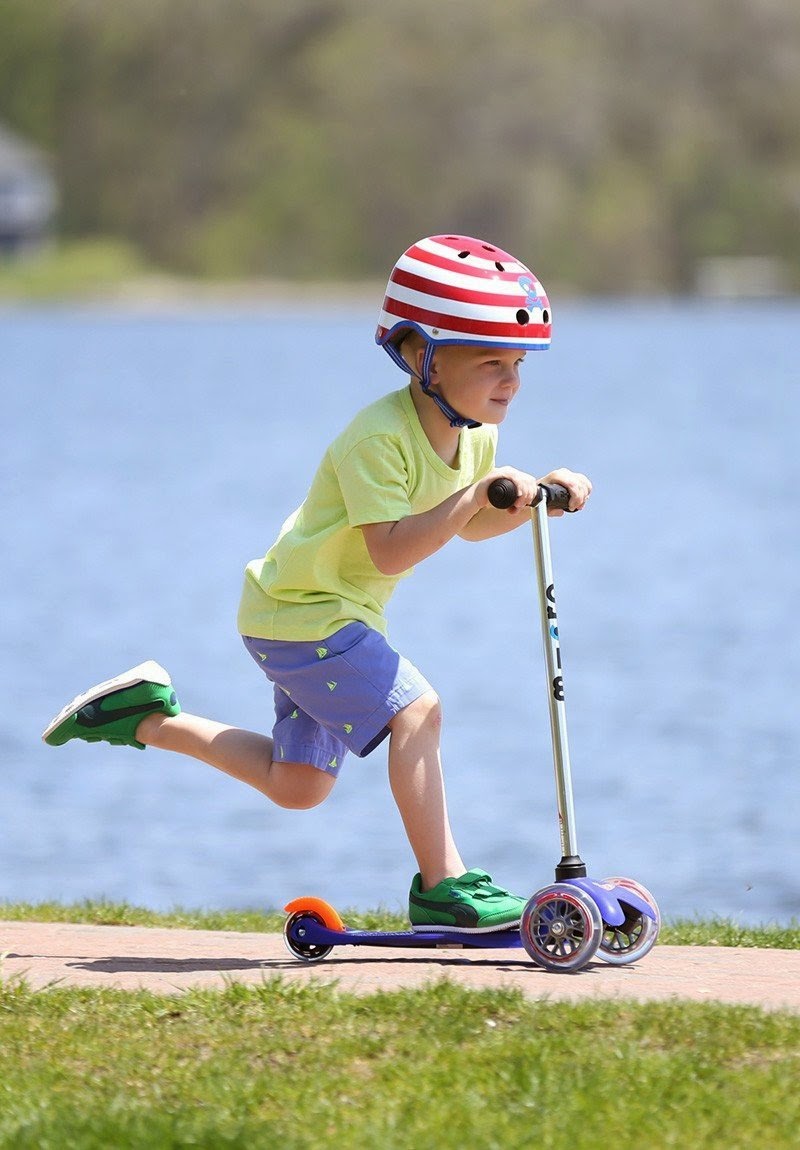
Ride a Scooter-in the winter, it's easier to get from place to place by throwing your kid in the stroller and not having to worry about them getting cold or slipping on the ice.  Now that it is nicer out, make sure you leave enough time in your day to allow your kids to get themselves to places on their own two feet.  Whether it be walking or scooting, getting your kids moving is key.  My favorite is the Mini Micro Kick scooter as I have found that it is light weight and easy for the kids I work with to use.  Even the kids on my caseload who have difficulties with balance, coordination and motor planning have success with this scooter.  So many parents come to me and tell me that the hardest time of their child's day is starting the school day.  Oftentimes, I find that kids are rushed through their morning routines, thrown into their strollers so they can be brought to school on time and then are thrown into the morning craziness and get overwhelmed and have difficulty.  When possible, I suggest to parents that they let their kids walk part of the way.  Even better, let them scoot the whole way.  It provides them with an incredible amount of organizing input to their sensory system.  The foot to pavement action gives them a ton of deep proprioceptive input that helps kids to be more organized and ready for a great day at school.
**one of the biggest complaints I get from parents about getting their kids to use a scooter is that they don't like the helmets and how they feel.  Take your kid to the store with you and have them try on helmets and let them pick which one they want.  Kids are way more likely to wear a helmet if they feel like it's one that they really like!

Chalk It Up!-one of my favorite things about the warmer weather is coming home at the end of the work day and seeing my own daughter outside drawing with chalk in front of our apartment.  She has learned how to write her name, draw pictures of people and so many other great things.  Writing with chalk is a great activity and can really be most enjoyed during this beautiful spring weather.  There are so many chalk choices these days:  think, thick, one colored or rainbow, egg or square shaped.  Keep in mind that using thinner chalk will most resemble a writing instrument in turn encouraging a proper grasp when using writing instruments.  If you can, have your kids draw on an elevated surface to work on increasing upper extremity strength.  If you don't have a driveway or a place in front of your apartment, grab the chalk and go to the playground.
You can make this a social experience by gathering a few kids together and having them make pictures together.  For example, draw a picture of a person and have each kid add their how part to complete the person. Or play a game of tic-tac-toe or hangman.  You can work on letter recognition, executive functioning and social skills at the same time!  If you have the space, you can have your kids draw a hopscotch board so they can work on improving gross motor skills too!

Bubblerama!-I don't know what it is, but kids and bubbles go together like bread and butter.  They just love blowing them, chasing them, catching and popping them!  A fun thing you can do with your kids is make your own bubbles.  Sure, you can go out and buy bubbles anywhere, but making them can be really fun and is really easy.  It is also great for working on a lot of occupational therapy goals in such a fun way that your kids don't even realize that they are working.  For example, you can work on improving bilateral coordination (holding bowl while pouring ingredients in and stirring all the ingredients together), increasing upper body strength (stirring the ingredients) and working on improving executive functioning skills like focus, attention and organizational skills.  For older kids, you can give them a list of all the supplies needed for the activity and have them gather them before beginning.  You can also write out the steps on a piece of paper, cut them into strips and have the kids put the directions in the proper order before beginning the activity.

To make your own bubbles, check out this recipe:
6 cups water (you can use tap but distilled is better)
1/2 cup blue Dawn dish detergent
1/2 cup corn starch
1 tablespoon baking POWDER
1 tablespoon glycerine

Dissolve the cornstarch in the water, stirring really well.  Once the cornstarch is completely dissolved, gently stir in the remaining ingredients (in no particular order) trying to not make too much froth.  Let the mixture sit for at least an hour, stirring occasionally if you see that the cornstarch is settling to the bottom.   Don't get discouraged if your first few bubbles don't come out too great...the mixture gets better after a few uses.

You can use bubble wands and blow bubbles (great for improving oral motor strength) or you can make your own super big bubble wand using straws and yarn (you need your yarn to measure about 6 to 8 times the length of a straw).  Take the yarn and string it through the straws, tie a knot and you have your bubble wand.  You can take your bubble solution and put it in a big bucket and start making giant bubbles!  Guaranteed fun for kids of all ages!


These are just a handful of fun and simple activities that you can do with your kids now that the weather is nicer.  I have chosen activities that can be done whether you live in the city or in the country...they just may need to be adapted based on what kind of space you have.  What are you most excited about doing with your kids now that spring is actually here?  Please feel free to share your fun outdoor activities with me and my readers.  I'm just a click away and love hearing from each and ever one of you!   I am looking forward to a fun-filled outdoor weekend with my own family and wish you all a very happy and warm weekend!


Wednesday, June 4, 2014

I'm Going to Huff and Puff.....and Calm Myself Down!

This is going to be a quick post, but one that I think will be super valuable.  I am not sure about any of you, but I find May and June to be harder than almost any other time of the school year.  So many of my kids are feeling nervous and worried about all the changes that summer usually brings about.  For some of them, it's ending school and realizing they will be in a new school next year with so many new faces.  Others are worried about camp, taking a bus for the first time.  Whatever the changes are, it often brings about kids with increased energy and more difficulty with being able to modulate/regulate their behaviors.


One of the skills I love to teach children when they present with these types of behaviors is how to take deep breaths.  When a child is feeling anxious or scared, his or her breathing will change and instead of taking normal breaths, they will be observed to take short, quick and shallow breaths.  Deep breathing is
important because it can lower a child's anxiety and give them a sense of control over their body.  Teaching a child how to do calm breathing is a great tool that they can have with them at all times, especially when their grownups aren't there to help guide them through it.  However, teaching children, especially the younger ones, how to properly take deep breaths can be more challenging than one may think.


Ever since discovering Free App Friday by Smart Apps For Kids, I have found a handful of great apps.  Ones that I most definitely wouldn't have discovered without me reading it about on their post.  Last week, one of the apps features was Huff-N-Puff by Duckie Deck.  Their description of the game is:  Huff n' PUff lets children learn about physical effects of wind and air, in a simplified setting.  Now, a youngster can have a more direct interaction with the digital world by using the power of their own breath.  Just blow some air near the iPad's or iPhone's iOS 5 microphone and delight in the realistic effect on-screen.  As an occupational therapist, I read this as follows:  Huff n' Puff lets children learn about how to effectively take deep and controlled breaths in a fun, motivated and simple setting.


There isn't much to the game, but it is fun and so far, my kids are loving it!  There are about 25 different activities that your child can play with.  I
pick and choose which ones are most appropriate and most motivating for the child I am working with.  The only thing the child needs to do is breath into the microphone of the iPad or iPhone and something fun will happen.  So far, my favorites are blowing the seeds off the dandelion, making the pinwheel spin or blowing the whistle.  I like these because they require a child to work on sustaining a long, deep breath.  I sometimes challenge my kids to see how many times they can make the pinwheel spin which they love!

One thing I really love about this game is there are ways to generalize and practice your deep breathing with real life activities.  For example, one of the activities is to blow up a balloon.  Right after you blow the balloon up on the game, you can have a child practice using those deep breaths by blowing up a real balloon.  Who remembers that pipe where you have to keep the ball in the air without having it fly away?  They have that as an activity on this game!  I have a few of the real pipes at work and the kids love it, but they often have trouble with it.  Some of my kids think it is really funny to make it fly away and have to chase it.  I am going to see if I can get them to be more successful by practicing with Huff-N-Puff first.

I hope you all have as much fun with this game as I am having.  Deep breathing is such an important skill and I have struggled with finding the most effective way to help my kids learn this skill.  It is an essential skill for learning how to cope when faced with challenging situations.  I am sure many of you have other ways to work on this without using technology and I would love to hear from with your ideas.  As the end of the year approaches and our kids are faced with an increased number of changes and challenges, I would love to be able to help empower them with a skill that will help them get through these difficult times.  

Wednesday, November 13, 2013

2013 Holiday Gift Guide

I honestly can't believe it's that time of year already.  It seems like it was just yesterday when I put together last year's gift guide.  I'm not sure how long I have been doing this, but I can date myself by saying that I know it is only in the last couple of years that I have added an iPad app section.

Year after year, families I work with ask for suggestions on not only what they can get for their kids for the holidays, but also what they can tell their friends and families to get.  As we all know, there is an overwhelming number of toys out there.  The commercials for light up pillows, animal slippers whose mouths open when you take steps, mood sand and magic markers are enough to drive us all mad and into the poor house!

My goal for my gift giving guide is to provide you with items that are not only fun, but will have a therapeutic value for those of you whose child needs that.  For the most part, the things I recommend are items which can be used by all children, not only those that need support.  They are (for the most part), items that can be purchased in local toy stores or online. Anyone who follows this blog knows that I love to support the local toy stores!

I hope you find this list helpful.  If you click on the name of each product, you will be directed to the website or a place where you can purchase that item.

Please use the list below to reference the abbreviations under each product.  These codes will tell you what skills can be addressed using the toy, game, app, etc.


FM- improves fine motor skills
GR- improves fine motor grasping skills and in-hand manipulation skills
VM- improves visual motor skills
VP- improves visual perceptual skills/visual scanning skills
EH- improves eye-hand coordination skills
SP- improves sensory processing skills, such as attention and focus
SA- improves safety awareness
MP- improves motor planning skills
ST- improves strength
BC- improves bilateral coordination/using two hands at the same time
EF- improves executive functioning skills
SS- improves social skills
GM- improves gross motor skills (jumping or whole body movements)
SC/Ind- improves self-care and activities of daily living skills; improves independence 

Happy Holidays to you all!  I hope that they are filled with lots of love and laughter and, for the little people in your life, lots of fun and playing!

Drawing Books
Don't Let the Pigeon Finish This Activity Book-I am a huge fan of all things Mo Willems so when I saw this book in the Community Bookstore in Park Slope, I had to get it.  It's a great book with a variety of really fun activities for kids.  Opportunities to practice writing letters, drawing and coloring with your favorite characters from the Mo Willem books.  One of the things I really like about this book is that there are some activities that can take more than one session.
GR  VM  EH  FM


Lazoo-there are nine different books to choose from and I can't say one is better than the other.  I adore all of these and each one is so unique and different from other coloring and activity books.  My first book was the Holes book and my kids couldn't get enough.  I quickly picked up the Squiggles and Stickers/Incredible Stickers books.  Perfect for preschoolers who may not always love coloring and drawing books because the pictures are motivating and exciting for them to complete.  Many of the kids I work with get stressed with coloring books because the pictures are too big and their hands get tired.  With drawing, they avoid this task because they aren't quite sure where to start the picture.  These books are great because they give you something concrete to begin with and then you can allow your imagination to run wild.  These books allow for success and the more successful they are, the more likely they will be to try coloring and drawing activities outside of their comfort zone. Here is a link to the Lazoo Store....warning, you may not be able to stop yourself!
GR  VM  EH  FM

Zolocolor coloring books- I'm not going to lie.  I love when my kids at work want to use these books. The pictures are so fun to color and I find it therapeutic to just zone out and color with the kids.  My kids love these books because the shapes are fun to color in and you can do whatever you want.  For many of my kids, this ends up being a bit of a long-term project.  Great for older kids who love to color but have outgrown many of the character coloring books out there.
GR  VM  EH  FM


The Usborne Coloring Books- Another fantastic collection of coloring and drawing books for older kids.  These books are filled with beautiful pictures and designs to color in and/or complete the pictures.  For those kids who struggle with starting a drawing project, these books are great because they don't need to worry about that.  There are a bunch of different versions of this book so you will easily find one for your child (boy or girl) will enjoy.  Take a look at the picture on the left and you will see an example of just one of the images you can find in these books.  This one here allows you the jumping off point for so many things:  draw people in the windows of the houses/buildings or draw clothing hanging off the clothesline.  There is no right or wrong here.  It's about having fun and doing your best and at the end, they will have a picture they can be proud of!  I have seen these books at Barnes and Noble and many independent book stores.
GR  VM  EH  FM  EF  SP  SS

Arts and Crafts
Rainbow Loom- I blogged about this a few months ago and think it was by far my most popular post ever.  No surprise since the Rainbow Loom only gets more popular each and every day!  I can't say enough about this product.  I love that it has become so popular amongst school age kids and that you are seeing them excited about making bracelets and not glued to an iPhone, iPad or portable gaming device.  For kids with fine motor and motor planning difficulties, this may be difficult, but the amount of pride they feel when they master it is amazing.  For my older kids who need to work on executive functioning skills, I have them find a video on YouTube so they can follow the step-by-step instructions.  I have spent many hours on YouTube myself learning different bracelet patterns.  Many local toy stores sell the real loom (I am a bit of a Rainbow Loom snob and after trying a few of the knock-off brands, I won't use any but the real one) but if you have a Michael's nearby you will be sure to find a loom and dozens and dozens of different colored bands.
FM  GR  BC  EH  VM  SP

Orb Factory Mosaics- I have been using these in my private practice for years now.  It's hard to contain my love for them, evident by my previous blog posts here and here.  What I love about this company is that they could have easily stopped creating and still be super popular but they didn't do that.  Their products continue to grow and keep me coming back for more.  They have sets made for toddlers (matching different colored shapes) and for older kids (matching different colored squares and gems to assigned numbers).  They are all brilliant and at the end, the kids have an amazing piece of art that they get to take home and show to their loved ones.  This helps foster self-esteem and confidence which is the most important factor in a toy or craft.
FM  GR  BC  EH  VM  SP

Crayons- We all love the traditional set of Crayola crayons and I am not saying that you shouldn't have those in your house. In fact, no home would be complete without its own set!  As an occupational therapist, I would tell you to take those perfect crayons and break them in half to promote a proper grasp.  If you can't do that (and I totally understand...I cringe every time I do it myself), here are some crayons that will help in promoting a proper grasp for those of you who have children with strength or grasping issues:

Star Crayons- The shape of these crayons is perfect for encouraging a tripod grasp.  The star shape also makes all coloring and handwriting activities a little more fun for the little ones I work with!

Left Right Ergonomic Crayons: Perfect for those kids who are too young to have a hand dominance or kids who keep switching.  The shape is made so that no matter what hand you choose, you will be forced into a tripod-like grasp.

Crayon Rocks- Designed to strengthen the tripod grip muscles, which are essential for creating a proper grasp, and is so important for graphomotor and handwriting skill development.  Soy wax crayon,s that offer bright and vibrant colors, are small crayons whose size helps to encourage a tripod grasp.  Because they are small, there is no way that a child can't fist them, which is a common grasp I see with my younger kids.
FM  GR

Djeco Collages for Little Hands- Super cute set of animal collages perfect for your preschooler/early school age child.  Each set comes with four different collages that you can make.  Following the visual directions, you use a variety of materials to make a cute animal.  Great for working on early organizational skills in our little ones.  At the end, they have a set of four ridiculously adorable collages that they take great pride in.
FM  GR  BC  EH  VM  SP


Yellow Owl's Little Prints-as with many things these days, I discovered this book at Norman & Jules in Park Slope.  This book teaches readers a wide variety of crafting skills such as stenciling, printing and stamping in order to create different keepsakes, decorations and gifts that will make the special people in your life feel loved.  Great for the tweens/teens in your life who have outgrown many of the arts & crafts kits out there and want to be more hands-on with their crafts.  
GR  VM  EH  FM  EF  SP  SS

Hiho Batik-I blogged about this awesome Park Slope store months ago and you can read about my amazing experience here.  I can't say enough about this place and the people who run it.  There is a passion and devotion here that comes out in all the work they do.  Not only can you buy some of the coolest homemade clothes out there (Quinn's been sporting Hiho Batik clothing since the day they opened), you can make your own in their studio located at the back of the store.  I have gone for a 1:1 session and a birthday party and couldn't have been more impressed with the attention that goes into every detail.  Both times I went, the children needed a little extra love and attention; I mentioned it to Julia, store owner, before coming and she did everything in her power to make sure the time we spent there was a successful one.  Your child walks out of this experience with not only a really cool piece of clothing, but a sense of pride and confidence that is infectious.    Check out this link that shows a video of the make your own batik experience at Hiho Batik.  For those of you in the NYC area, gift certificates are available for purchase if you need a little something for the stocking.  This could be a great way to spend a cold and snowy winter day.
GR  VM  EH  FM  EF  SP  SS


Toys/Manipulatives
Tegu Blocks- I absolutely love these blocks.  Tegu Blocks are simple, wooden blocks that have a magnet inside.  So a child can not only build their sets up, but also out to the sides.  There are a variety of sets, including ones that allow you to build a moving car.   My daughter has been playing with these blocks for years and never tires of them.  They are more expensive than your typical wooden block sets, but they are not your typical blocks.  Because of how well made and durable they are, this is a toy that you will be able to pass down to your kid's kids in the years to come.
FM  GR  BC  EH  SP

Lego Duplo Read and Build- Legos seem to be another one of those toys that never get old.  When I discovered the Lego Duplo Read and Build Sets, I was so excited.  These sets are perfect for those smaller hands that have difficulty with the small size Legos.  The accompanying instructions are great because they give very clear visuals on how to build the different objects (jungle and farm animals, bugs/caterpillar, and a car set) in the book.  This requires a child to organize their work, plan what they are doing and follow visual directions.
FM  BC  EH  MP  ST

Ogobild Bits- I discovered this Brooklyn-based company last holiday season when I saw them at one of the many amazing holiday markets all over the city.  If you have kids who love building, but you have enough Lego sets, this is a great gift for them!  There are small and large sets and each comes with a bunch of suggested items to build.  Great for working on building a child's imagination skills while building the muscles of the hands!  I have used them in my social skills group both with preschoolers and school age kids and they had an absolute blast.
FM  BC  EH  MP  ST
MagnaTiles- I bought these years ago and my kids still love them.  These magnetic plastic shapes help foster creativity and imagination.  I have used this both in my 1:1 work and in my social skills groups.  Another toy that comes with a bit of a price tag, but will last forever.
FM  BC  EH  MP  ST  SS

LaQ- I discovered this awesome manipulative building set this summer after a trip to The Bronx Zoo.  For the Lego lovers, this is another great toy.  These are actually flat shapes that snap together to make a ton of different shapes.  For tons of different patterns to make cars, animals, people, etc. using these different shaped blocks, clink here.  My kids love them and I don't see them getting too frustrated when it gets difficult to follow the directions.  Better suited for the older kids I work with (often too difficult for the preschoolers, especially those with fine motor difficulties).
FM  BC  EH  MP  ST

Giraffe Safari Nest & Play Blocks- I've been a fan of Skip*Hop products since the beginning when they were just diaper bags.  A few years ago they began making really nice wooden toys.  This cute toy is ideal for your little ones (around 1 1/2 years old).  They can be stacked on top of each other, match the towering animals and then you can drop the ball into the holes.  For those of you who live in smaller spaces, they can nest inside of each other and take up little room.
BC  EH  MP

Giraffe Safari Stacking Animal Blocks- These adorable blocks are a perfect gift for those little people in your life.  Included is a set of five jungle animals that can be stacked on top of each other, lined up next to each other or used in conjunction with other block sets.  A great toy to work on improving play skills and teaching your child about different kinds of animals.
BC  EH  MP

Games
Stack Up- A great cooperative game perfect for preschoolers or young school age children.  The purpose of the game is to work as a team to build a stack of blocks using sticks (the blocks have a hole on either side and children must work together to put their stick in the hole and place it on top of the other blocks).  There are challenges as well that keep the kids on their feet and moving around.  I love watching the kids figure out how to work together to make the tower.  Cooperative games are great for teaching kids the importance of team work and that sometimes winning is not the most important part of a game!
BC SP GM

Spot It- I was late to the Spot It world but haven't turned back since I discovered it.  It's a great card game that works on matching, visual scanning and visual perceptual skills in a fast-paced fun way.  It's a perfect game for as few as two, and as many as six, kids.  It comes in a small and compact container that makes it easy to throw in a bag for car rides, train rides, etc. Kids don't seem to ever tire of this game and there are multiple ways to play to keep it fresh and exciting.  I have both Spot It and Spot It, Jr. and use both all the time.
SS  VP  SP  

Tumbling Monkeys- This is by far one of my most favorite games- ever!  It's fun for both my preschoolers and my school age kids.  It's similar to the game Kerplunk, but you have a tree filled with monkeys instead of a tower filled with marbles.  I let the children playing decide the rules of the game- mainly, is the winner the one with the least or the most monkeys?
SS  EH  VM  SP FM  GR 

Tenzi- I love this fast paced dice game.  Each container has 40 dice (10 of four different colors) and the rules are quite simple.  Roll all 10 dice at once and the first person to get all 10 dice to have the same number is the winner.  My older kids love this and come up with their own rules to play which is really heartening to see.  With my younger kids, I like to use five dice instead of 10. They often get the rules, but their hands are smaller and it is much more difficult to hold onto so many dice at a time.  Check out their website for different and exciting ways to play this game.
FM  GR  BC  EH  VM  SP SS

Perfection- An oldie but a goodie.  I use this game almost every day with my kids and they never get sick of it.  Perfection is great for learning shapes and improving matching skills.  For my older kids, I may use the timer but only if they want it.  Sometimes I hide the shapes in theraputty in order to work on increasing grasp strength at the same time.  The original version of the game is not so easy to find, but you can find it here. There is a newer version with different shapes, but instead of having to match 25 shapes, you only have to match nine which is good for much younger kids.
FM  GR  EH  VM  SP SS

Obstacles- I have fallen in love with the toy company Eeboo.  They have an amazing selection of games, crafts, etc.  I have used Obstacles both in my social groups and in my 1:1 sessions.  There are a bunch of cards that have barriers/hazards and a bunch of cards that have tools that can be used to overcome those barriers in order to get yourself home.  When used individually, I may have my kids who need to work on handwriting write out their thoughts and ideas.  When used in a group setting, you can pair kids up to work as a team to come up with the best way to overcome the obstacle with the tool they have.  I love games that can be adapted to meet the needs of a particular child and his/her goals and this is definitely one of them.  This game will provide hours and hours of entertainment to your child and encourage creativity and problem solving at the same time.
SP SS  EF

Gross Motor Toys
Kickboard Scooter- Once children have outgrown their strollers, I suggest parents get their kids a good scooter to get around on.  I live in NYC, but there are a lot of other families out there whose children are within walking distance of scool who would benefit from using a scooter.  The Mini-Micro scooter is perfect for your preschooler while your school-age child will love the Maxi-Micro scooter.
GM  SP  SA MP  ST  BC

OgoDisk- Another great product created by Brooklyn-based, OgoSport.  The OgoDisk is a perfect gross motor activity for your kids.  Super light and easy to bring to the park, playground or beach, this toy comes with two disks and a ball.  The disks are made from a hard foam outside which allows for a comfortable grip and a nylon-spandex center.  My kids have such a fun time with this activity and I love that it can be a social activity at the same time.
GM  SP  MP  ST  BC

Yogarilla Cards- I love using these yoga cards with all my kids.  The large cards provide a great visual for the kids to imitate and on the back of each card, there are alternate positions for those who may have difficulty with the poses.  I am not a yogi by any means, but I love using yoga to help organize, ground and get my kids to focus. I totally appreciate the instructions written on the back of each card that can be used when giving the instructions.  I have a lot of kids who typically hate yoga, but they love these cards and actually ask to use them.
GM  SP  MP  ST  BC  EF

Clothing/Dress-up 
EZ Sox- I have loved these socks since first reading about them years ago and have been recommending them to families ever since.  I even used them with my typically developing daughter who wanted to independently put her socks on.  They have expanded their products to not only offer a wider range of sock styles (in both  kids and grownup sizes) but also have underwear now.  I know that many of my kids who have fine motor difficulties have difficulty with dressing and undressing and I love that this company has created something that looks really cute and promotes independence for self-care skills.  With increased independence comes increased self-esteem and confidence.
SC/Ind  MP  BC  EF

Soft Clothing- As a therapist I'm very well aware of how sensitive some of the kids I work with are to clothing...the tags, the buttons, the seams, etc. Am I right, fellow therapists?  Which is where Soft Clothing comes into play. They offer a wide range of cute clothing made especially for these kids.  In addition to having seamless socks and underwear, they have really cute clothes that have wider necks (to avoid rubbing up against the skin and causing irritation) and are made from soft and comfortable fabrics.  We all know how much better we function when we are comfortable in our clothes, so the same goes for kids.  How can we expect them to have a good day if they aren't wearing clothes that make them feel good?  As a bonus, many of the pants have elastic waistbands so kids who have strength issues but want to be independent for dressing and undressing, can benefit from these clothes as well.  I have recommended this company to parents of kids with down syndrome who had decreased grasp and upper extremity causing dressing and undressing to be hard for them.
SC/Ind  MP  BC  EF

Magical Apparel Vests and Dress-up- For those of you who have kids with (some) sensory difficulties or fine motor delays, here is a set of dress-up clothes that will support them.  Large buttons and fasteners make it easier for them to be independent when putting these clothes on.  They are made to hold some weights to provide deep input to your child who may need that in order to remain calm in social situations.  Fun and Function, a fantastic therapeutic catalog, has many different costumes for your to choose from.
SC/Ind  MP  BC  EF  SS

Stocking Stuffers
Aaron's Thinking Putty- Who doesn't love putty?  I know that I still play with it, especially since my sister Kara discovered this awesome company.  This putty is great for working on increasing grasp strength and manipulation skills in a fun way.  There are all different kids of putty to choose from- magnetic, glow in the dark, see through and, my personal favorite, the changing color ones!
GR   FM  SP
Discovery Putty- I have been using theraputty with my kids for as long as I can remember.  I will take small objects and hid them in there to make it more fun.  How happy was I when I heard about Discovery Putty by Fun and Function?  There is a soft-resistance putty with 15 different food treats hidden inside and a firm-resistance putty with 15 different safari animals inside.  This is a fantastic way to work on building fine motor skills in a fun way.  My kids LOVE this putty and ask for it over and over again.
GR  VM  EH  FM  SP  SS
Zoo Sticks- I use these chopsticks all the time with my kids.  This is a fun way to encourage kids to eat while working on increasing grasp strength at the same time.  They are not only good for eating, but it's a fun way to pick up small toys and sort them into different containers.  Kids love them and don't even realize that they are working when they play with them.  The best part? There are over 30 different ones to choose from!
GR  VM  EH  FM  EF  SP  SS
Marbleous Necklaces- I have to give a little shout out to two of my favorite 9-year olds who came up with the idea for these beautiful necklaces and their moms for supporting their creativity and turning it into a reality.  If you're looking for a special gift made with love, please check out their Facebook page.  These necklaces can be custom made for special events.  I have actually had to give the necklace off my body to someone who loved it so much!  As if this couldn't get any sweeter, I'm happy to share that 10% of the annual proceeds will go to Autism Speaks because the people behind this awesomeness believe in giving and spreading love, tolerance, joy and hope.

For all you locals, you can head to Norman and Jules in Park Slope to browse through their special selection of Marblous Necklaces!

iPad Apps
  I love using the iPad during my therapy sessions.  I don't use it alone, but find it to be a truly motivating tool, especially for things like handwriting, learning letters and drawing pictures.  I don't want to say that using the iPad is the end all and be all of therapy, but my kids work harder and generalize skills.  When used in conjunction with more hands-on experiences, like paper and pencils, I find that progress is seen faster.  
Lately, I have found more apps that focus on improving fine motor skills such as pinching, grasping, etc.  Here are just a few of my- I mean the kids'- favorites!

*I highly recommend using a stylus as often as possible when using the iPad in order to work on developing a proper grasp on a writing instrument.  Check out this crayon stylus by iCreate or this number 2 pencil stylus by Amin Swessi Designs. Each link will bring you to my blog posts which describe each one in depth along with all the OT goals that can be addressed by using these apps.  

Pepi Tree- I find myself playing this app every once in a while without any kids around.  The animals are so cute and I love that you can work on improving fine motor, visual motor and sensory-processing skills while also working on building language skills.

Bugs and Buttons/Bugs and Buttons 2-Little Bit Studio offers some of the finest apps out there. The best part is that each of their apps contains 18 fun and motivating games that work on a variety of educational games.  My kids don't tire of these apps and since there are so many games available, you can go weeks without repeating a game!

Bugs and Bubbles- Another amazing app by Little Bit Studio   Honestly, I can't get enough of this app and how many occupational therapy goals can be addressed when using it.

Face iMake ABC- This app provides users with a great way to learn the ABCs and work on improving visual motor, visual perceptual and matching skills. iMagineMachine outdid themselves with this app.  Be sure to check out their link here because there are plenty of other amazing apps to choose from that will not only entertain but educate your children.

Don't Let the Pigeon Run This App- Not only great for working on OT skills, but my speech therapy friends love using this entertaining app to work on language skills with the kids on their caseload.  Totally worth the more expensive price tag than I normally pay for a single app.

Lazoo Apps- There are five apps by this brilliant company.  Many of them are free and the ones that cost anything are well worth the small price tag!

Pinch Peeps- A great, free app.  It's perfect for older children who need to work on finger strength and grasping skills.  The more peeps you pinch, the more challenges you face so it keeps a child on their toes and maintaining their attention.

Dexteria Jr.- A great app that works on improving fine motor skills in pre-school age children (although many of the older children I work with love it as well).  This app is so much fun that the kids don't even realize they are working!

Doodlecast-Sago Mini- Offers an amazingly creative and fun line of apps for toddlers and preschoolers. I am a tremendous fan of Doodlecast, but my 3 1/2 year old daughter just loves all of their apps that we have on our iPad.

Toca Boca- I really love their line of apps. In fact, it's hard to have any self-control when looking through their amazing selection of apps.  Highly motivating and educational apps that will provide entertainment for all family members.  My favorites (and it is really difficult to choose) are Paint My Wings, Toca House and Toca Cars.

These are just a few but there are so many apps out there. Please email me if you want more specific suggestions for any particular skill. The apps listed above are a very small sampling of what I have reviewed and what I have on my iPad.

NYC Area Toy Stores
I say this on each and every blog post, but it is more important to me this time of the year: shop small business when possible.  Support those local toy and book stores near you.  These people work so hard and provide so much to your neighborhoods.  Here are a few of the local small businesses that I support throughout the year in NYC:

Norman and Jules- Park Slope, Brooklyn.  This is a beautiful toy store located in the heart of Park Slope with the most amazing selection of wooden toys and games.  One of my favorite things about this store is that there is almost nothing in the store that requires batteries.  Courtney and Avi do a tremendous amount of research to get the best of the best in there and are always willing to help a customer find the perfect gift.

Little Things- Park Slope, Brooklyn.  Two locations- one dedicated to Lego, Arts and Crafts and Seasonal items while other has dolls, games, baby toys, etc.  A true go-to store for all your holiday shopping!

Acorn- This small toy store has a beautiful selection of wooden toys, doll houses and dolls.  If you are looking for a special toy for a special person in your life, this is a perfect place to check out.

Stationery Toy World-I have worked on the UWS for 10 years now and have been shopping in this store for just as long.  The owner, Donna, is incredibly helpful and dedicated to keeping the most popular items in stock.  If you need suggestions on what to buy for a particular child, she will help you out.  You may pay more here than on Amazon, but the customer service is unbeatable.

Kidding Around- A great toy store with locations in both Chelsea and Grand Central Station.  There is a wonderful selection of games, puzzles, arts and crafts supplies and all other play essentials.  I have always found the staff to be friendly and helpful when looking for gifts.

Greenlight Bookstore- Fort Greene, Brooklyn.  An awesome selection of kid's books.  I never leave this store without something wonderful!

A Time for Children- Located on the UWS of Manhattan.  A Time for Children is owned and operated by a NYC-based philanthropy and donates 100% of its profits to The Children's Aid Society.  Here you will find a special selection of toys, clothes and gifts.

Toy Stores Outside of NYC Suggested by Others
Magic Beans- Four locations in the Boston area.  Independently owned and operated by parents.  They have a wide selection of baby, toddler, kid and educational toys.

The Village Bookstore- Littleton, NH. I grew up in Northern New Hampshire so I may be a little (or a lot!) biased, but this is so much more than a bookstore. Some of my happiest childhood memories are from when my sisters and I were cut loose downstairs in the children's/toy/play section. Here you will find an amazing selection of toys, puzzles and arts and craft supplies.

Animal Instinct- Ogunquit, Maine.  I hit this toy store up every summer on vacation.  There is a great selection of toys, games, puzzles and books.  I am a bit of a sucker for their Maine/Moose section when you first walk into the store!

Mom and Pop Place- Neenah, Wisconsin.  This is a natural parenting store and baby store featuring wooden toys, cloth diapers and other baby essentials.

Go Bananas- There are two locations in Loudon County, Virginia.  About 30 miles west of Washington DC.  It's an award-winning family-owned and operated specialty toy and gift store for children.

Fun Stuff Toys- Seaford, New York.  Specializing in kids' toys, here you can shop for creative, educational, developmental games, puzzles and specialty toys.  

Whirlygigs- Exeter, NH.  A classic shop from the past packed with toys of every kind.  From the latest craze to the classic toys you grew up with, they can help you find what you are looking for.

Matty's Toy Stop- Nassau County, Long Island, New York.  With multiple locations, this store offers a great selection of kids toys, educational items, learning and fun toys for all ages.

The Acorn Store-Santa Monica, California.  There is a beautiful selection of wooden and imaginative toys for children from birth to school age.

Wonderland- Brentwood, California.  A magical placed filled with quality treasures and gifts that will satisfy the fun inside of you all!  They scour the planet for unique, specialty toys that will be fun and educational for all kids.  

JennyBec's-Brentwood, California.  From books, toys, games, furniture, wall art and fine linens, you will find all you want from newborn through tween.  They pride themselves on being able to provide practically any gift, toy or furnishing!

Growing Tree Toys- State College, PA.  They offer a quality selection of educational toys to aid child creativity and intellectual growth.

Oliver's Trains & Toys- Evanston, Illinois.  A small, family operated toy store in the suburbs of Chicago. This store offers a wonderful selection of trains and educational toys.

Becky & Me Toys- Evanston, Illinois.  Becky was a teacher with 15 years of early childhood experience.  Here they try out the toys, play the games and read the books before they put them out on the shelves of their store.  They are constantly looking for new companies and products that have value to all the children who walk in their door.

Creative Kidstuff-Twin Cities, MN.  This store specialized in creative, innovative and educational toys.  They have a staff full of knowledgeable and kind-hearted people who truly love kids.

A2Z Science & Learning Store-located in downtown Northampton, MA, this toy store is filled with educational toys, skill toys, construction toys, flying toys, books, games, minerals and fossils.

The Toy Box-Amherst, MA.  This store has a dynamic environment where kids and adults are encouraged to play!  They pride themselves on their high level of service and hand picked products.

***I would love to add to this list, so if you have any other suggestions of great toy stores in your neck of the woods, please let me know.  I am a click away and would love nothing more than to generate a list of small, independent and specialty toy stores that we can all support***

I hope that you find this list helpful and that there is something special for the little (or not so little) people in your lives.  If you have anything you would like me to add to the list, please let me know.  I am always looking for new toys and products to motivate the kids I work with to learn and gain new skills.  Email me and I will add to this list.  I know there are a million other great things out there and I look forward to hearing from you about them.

I tried to add as many new things as possible to this year's list.  However, there are so many other great toys and activities out there for you to know about.  Please check out my previous years' lists if you need or want additional ideas:
2012 Holiday Gift Guide
2011 Holiday Gift Guide

Most of all, I hope that you have a very happy and healthy holiday season.  May joy fill your hearts and homes.  May the New Year bring health and happiness to you and those you love.  Thank you for joining me this year and helping me help you!  I look forward to the upcoming New Year and discovering and sharing all kinds of new toys, crafts, activities and apps with you.

Thank you and happy, happy holidays,
Meghan